


An offshore container has to do more than hold equipment. It must protect the cargo, fit the route through a supply base and vessel, and arrive with documents that match the way it will be lifted and used. A container that looks ideal on a dimension sheet can still cause trouble if a pump cannot pass through its door, a heavy item overloads one part of the floor, or the lifting set is outside the approval scope.
The most reliable way to choose is to start with the cargo and its journey. Describe what will go inside, how it will be loaded, where it will be lifted, and what will happen after it reaches the installation. Only then choose the container type and confirm the applicable standard.
The short answer: match the container to the job
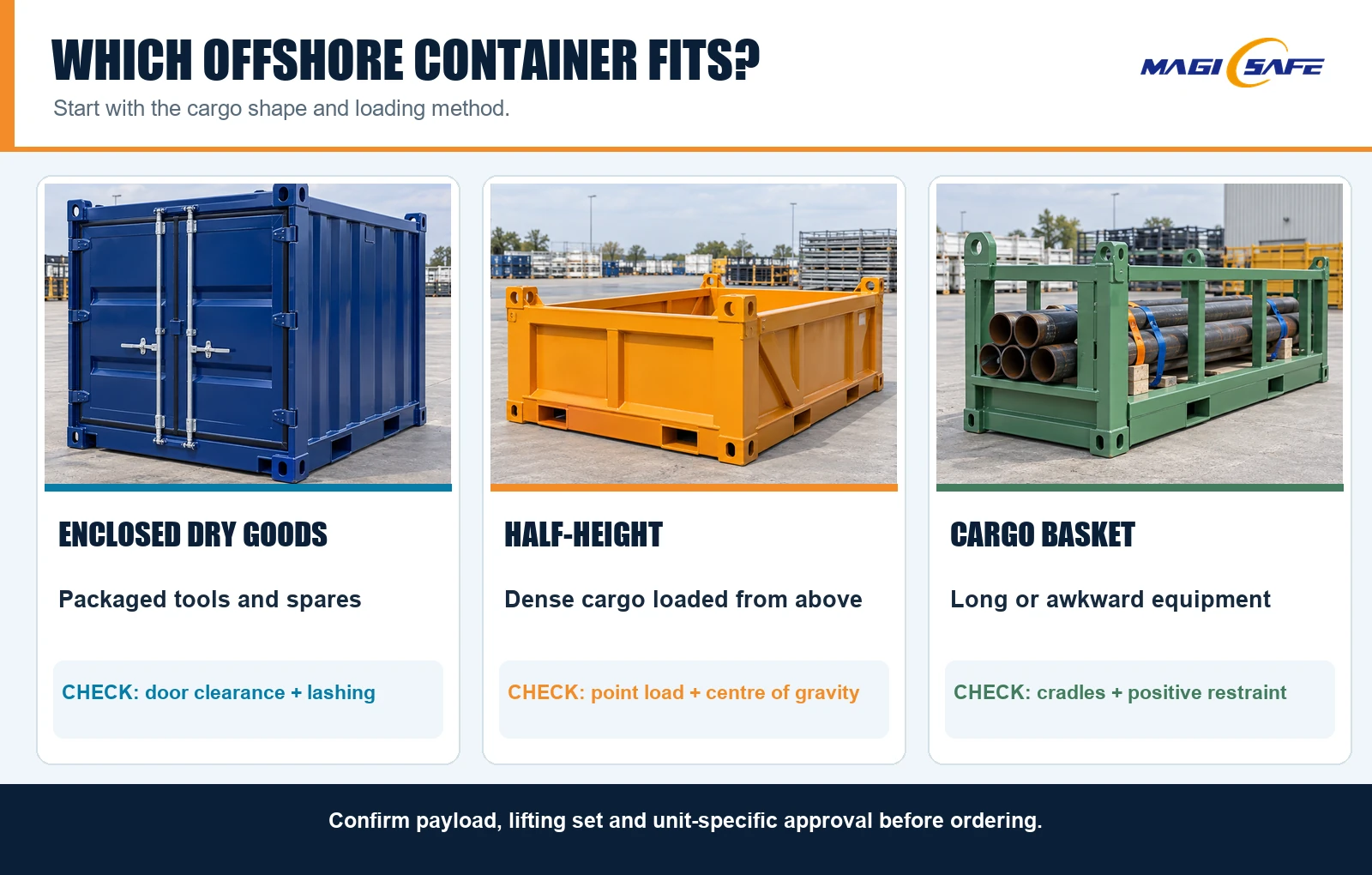
For general tools and packaged spares that need weather protection, begin with an enclosed dry goods offshore container. For dense cargo that can be loaded over the side, consider a half-height container. Long or awkward items may call for an open-top unit, cargo basket or dedicated transport frame. Temperature-sensitive material needs a refrigerated solution with a verified power and monitoring plan. Liquids need a purpose-designed offshore tank, while a workshop or equipment module should be assessed as an operational assembly, not simply as an empty cargo box.
That is a starting point, not a specification. The final choice also depends on payload, internal clearances, loading method, restraint, lifting arrangement, deck footprint, local operating rules and the exact certification of the supplied unit.
Offshore containers VS ordinary shipping containers
A standard ISO freight container may be suitable for intermodal transport, but a CSC plate alone does not establish that it is suitable for the offshore lifting duty on a vessel or installation. Offshore cargo-carrying units are designed around that handling environment: their structure, lifting points and lifting set are evaluated for the applicable offshore-container standard. The approval has to match the actual unit and its intended service.
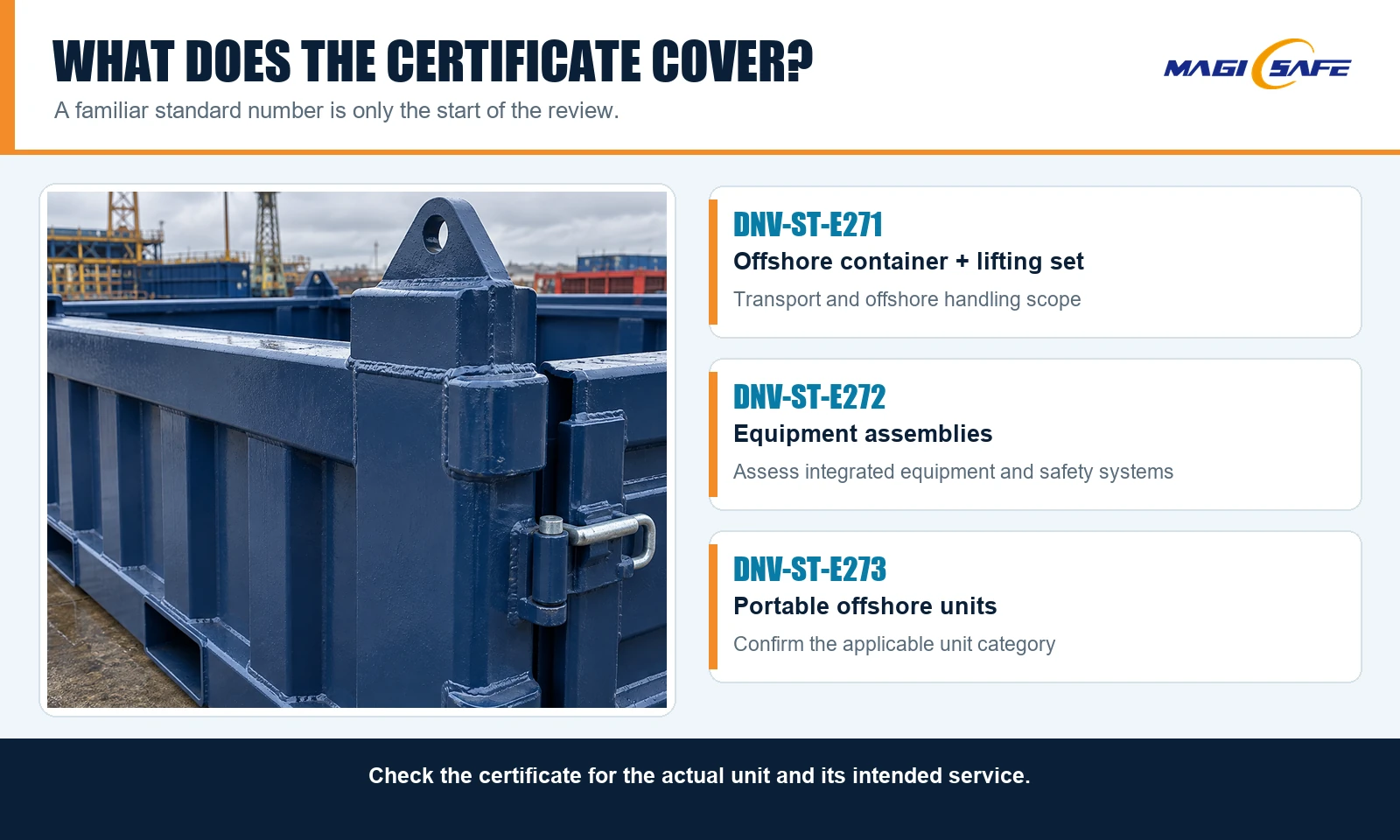
The most familiar reference is DNV-ST-E271 (2.7-1), which covers offshore containers and their lifting sets. ISO 10855 and EN 12079 may also appear in project specifications. Confirm the edition, certification body, certificate number and scope rather than accepting the phrase “DNV type” as evidence. A claim that a unit was built to a DNV standard is not the same as a certificate issued by DNV for that unit.
Some installations need more than cargo transport. DNV-ST-E272 (2.7-2) addresses equipment assemblies, including safety and integration requirements that may matter for a fitted workshop or technical module. DNV-ST-E273 (2.7-3) applies to portable offshore units. The right route depends on the complete assembly and its operating role; a 2.7-1 cargo-container certificate does not automatically approve installed electrical equipment, a hazardous-area installation, personnel occupancy or subsea deployment.
Which offshore container type fits the cargo?
Container type | Usually a good fit for | Check before ordering |
|---|---|---|
Enclosed dry goods container | Packaged spares, tools, consumables and cargo needing weather protection | Door clear opening, internal lashing, shelves or racks, floor capacity and drainage |
Half-height container | Dense machinery, valves, pipe fittings and other heavy items loaded from above | Side access, local floor loading, centre of gravity, restraint and lifting clearance |
Open-top container | Tall or irregular cargo that cannot pass through a standard door | Weather cover, lifting access, top restraint and transport envelope |
Cargo basket or transport frame | Long tubulars, hoses, subsea equipment or unusual shapes | Dedicated cradles, tie-down positions, handling method and whether the basket is approved for the specific service |
Refrigerated container | Temperature-controlled supplies and sensitive materials | Temperature range, power source, monitoring, backup strategy and door-opening frequency |
Compatible liquids and chemical transfer | Product compatibility, tank code, pressure/venting, fittings, cleaning and dangerous-goods requirements | |
Tools and equipment that must be used inside the unit offshore | Fire safety, ventilation, electrical classification, escape, utilities and assembly-level approval |
The table is a practical screening tool. A long cargo item may fit an open-top box but still need a purpose-built basket because of how it is restrained and lifted. A heavy item may fit inside a half-height unit by weight while exceeding the permitted load over a small patch of floor.
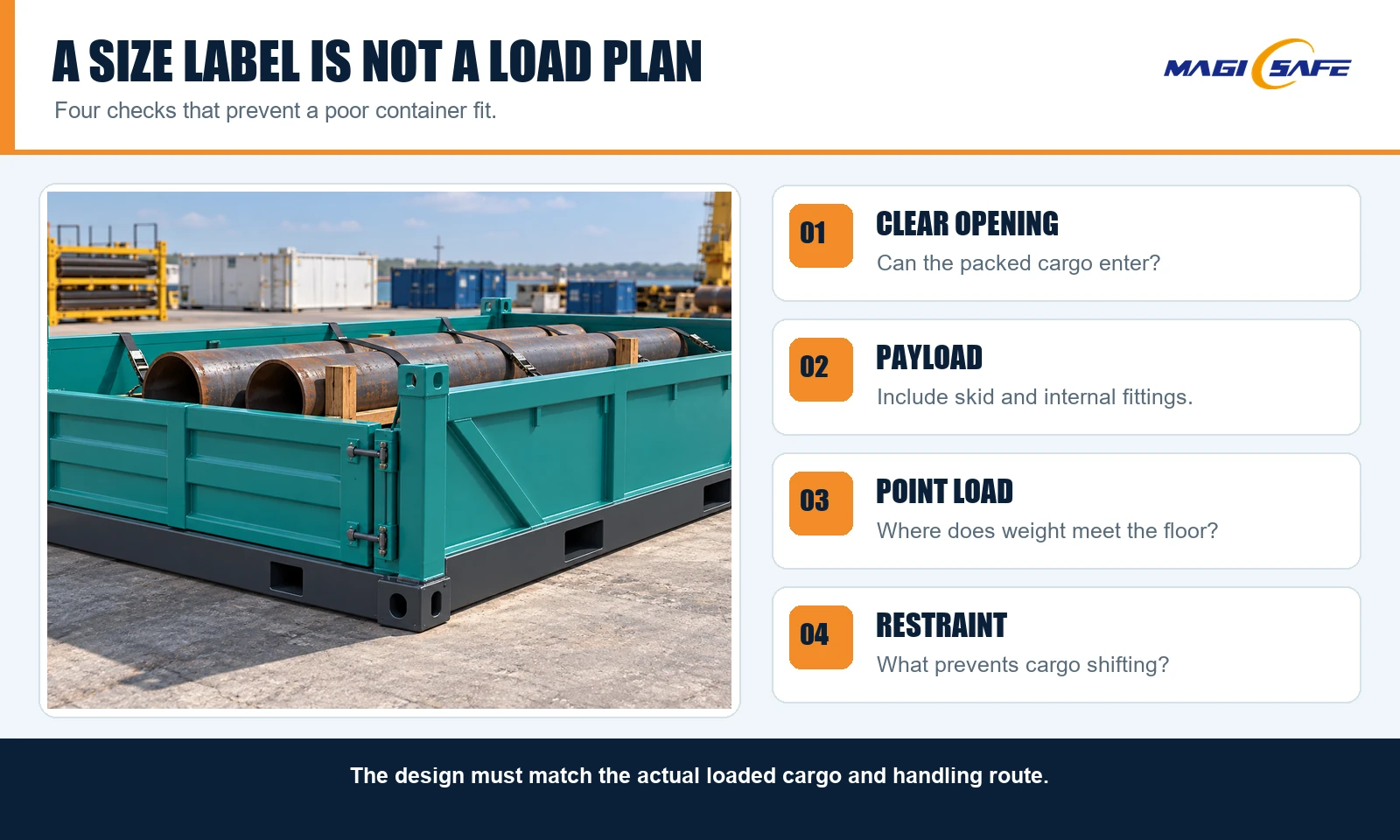
Work through the load before choosing a size
The familiar “10 ft” or “20 ft” description is an outside size class. It tells you little about whether the cargo can enter and be secured. Record the cargo’s length, width, height and mass, including its packaging, skid and any protruding fittings. Then compare them with the clear door opening, usable internal dimensions and the route the cargo will take inside the unit. Leave room for handling and restraint, not just a theoretical tight fit.
Next, calculate the expected loaded mass: container tare, cargo, internal fixtures and any other items that count toward the unit’s marked maximum gross weight. The nominal payload is normally maximum gross weight minus tare, but that subtraction is only the beginning. Ask for the permissible floor loading, point loads, load distribution and centre-of-gravity limits. A compact winch on four small feet behaves differently from the same mass spread across a skid.
Restraint deserves its own sketch. Identify the number and position of lashing points, how slings or straps reach the cargo, whether a barrier is needed at the door, and how items will be removed at the destination. Unrestrained small objects and a single heavy item that can shift are both offshore handling problems. Open baskets also need a positive plan to prevent loose contents escaping.
Follow the full transport and lifting route
An offshore cargo unit may move by road, forklift, quayside crane, supply vessel and installation crane before it is opened. Check the least forgiving part of that route. A wide container may fit on deck but conflict with a vessel walkway; a high load may have insufficient crane-hook clearance; a basket may be difficult to land where a closed box would be straightforward.
Ask the operator which lifting arrangement it accepts: sling configuration, shackles, master link, lifting-set certification, inspection status and any site-specific colour or tagging rules. Confirm whether the proposed unit can be stacked or fork-handled in its loaded condition. Those capabilities should be stated for the supplied configuration, not inferred from how the unit looks.
If the cargo will be sent overboard or placed on the seabed, say so explicitly at enquiry stage. An ordinary offshore cargo basket is not automatically a subsea basket. Immersion, retrieval, snagging risk, drainage, corrosion and subsea handling can change both the design and the approval route. MagOffshore offers separate offshore cargo containers and subsea basket product lines; the project specification must determine which is appropriate.
Treat special cargo as a separate engineering decision
Liquids and chemicals
A dry goods box is not a substitute for a tank. Specify the exact liquid, concentration, operating temperature, density, cleaning medium and filling/discharge method. Material compatibility includes the tank shell, seals, valves and hose connections. If the product is dangerous goods, packaging and transport requirements need a separate review; an offshore lift certificate does not by itself authorize the contents.
Temperature-sensitive cargo
A reefer needs more than a set-point. Confirm the permitted temperature band, power connections at each stage, monitoring, alarms and what happens during transfer between power sources. The cargo owner should state the maximum acceptable interruption and documentation needed to show that the condition was maintained.
People or powered equipment inside a module
A workshop, laboratory or equipment shelter is a working system. The specification may need ventilation, fire and gas detection, emergency exits, electrical equipment suitable for the area, and utility interfaces. Avoid buying a standard cargo container and adding equipment later without reviewing the complete assembly and its certification scope.
Check the certificate package before the purchase order
Request the documents for the actual serial-numbered unit or for the defined production batch and scope, as applicable. The useful package commonly includes a design or type approval reference, unit certificate, lifting-set documentation, test and inspection records, material and weld traceability where required, and the manufacturer’s operating/maintenance information. Review the marking plate and documents together: maximum gross weight, tare, payload, sling identification and inspection status should agree.
For modified units, ask whether the change affects the original approval and whether the updated configuration has been reviewed. A larger hatch, added equipment, new lifting attachment or altered frame can change load paths and document scope. Also agree who will manage periodic inspection and replacement lifting gear after delivery. A strong purchase decision includes the lifetime paperwork, not only the factory handover file.
A practical RFQ for an offshore container supplier
Send a brief that allows suppliers to design against the same duty. Include:
Cargo description, dimensions, mass, packaging, lifting points and centre of gravity, plus any dangerous-goods classification.
Loading and unloading method, including forklift, overhead crane, side access, top access and destination deck constraints.
Required external envelope, clear openings, payload, floor or point-load requirements, internal restraints and weather protection.
Marine route and intended service: offshore lift, installed equipment use, subsea deployment or a combination that needs separate assessment.
Applicable project standards, certification body requirements, latest acceptable inspection date and required document package.
Optional fittings such as shelves, cradles, spill containment, refrigeration, power, ventilation or corrosion protection.
Delivery location, requested date, drawing approval process and after-delivery inspection responsibilities.
Give suppliers a chance to challenge the chosen box type. A well-supported recommendation may replace an oversized dry container with a smaller purpose-built basket, or identify why an apparently cheaper unit would require difficult handling offshore.
Where MagOffshore fits
MagOffshore’s published range includes DNV 2.7-1 offshore cargo containers, subsea baskets and workshop containers. That breadth is useful when the first decision is the configuration rather than the final dimensions. For a new project, send the cargo sketch, lifting route and required approval scope to the supplier and request a drawing, equipment list and unit-specific documents before committing to a design.
The best offshore container is the one whose geometry, load path and paperwork fit the job together. Starting with those three questions usually produces a better purchase specification than starting with a length or a catalogue photograph.
Frequently asked questions
Is a CSC-plated shipping container enough for offshore lifting?
No. CSC addresses freight-container safety in its own scope. The offshore lifting duty requires an appropriate offshore-container design and approval, including the lifting set, according to the operator’s specification.
Is DNV 2.7-1 the same as DNV certification?
No. A unit may be described as certified to a DNV standard by an approved body, while “DNV-certified” specifically implies certification issued by DNV. Ask for the issuing body and certificate for the exact unit.
Should I choose an open-top container or a cargo basket?
Choose by cargo geometry and restraint. An open-top box can offer containment with top-loading access; a basket or frame may suit long, awkward cargo and dedicated cradles. Verify the design and approval for the actual handling route.
Does a 2.7-1 certificate cover a fitted workshop?
It establishes the scope stated on that certificate. Installed equipment, electrical systems and the safe operation of the complete module may require additional assessment under other applicable standards and project rules.
What information should be confirmed before asking for a price?
At minimum, provide the cargo envelope and mass, loading method, lift route, destination constraints, required standard and documentation, and any environmental or hazardous-area requirements. A supplier can then quote a defined configuration rather than a generic size.
-
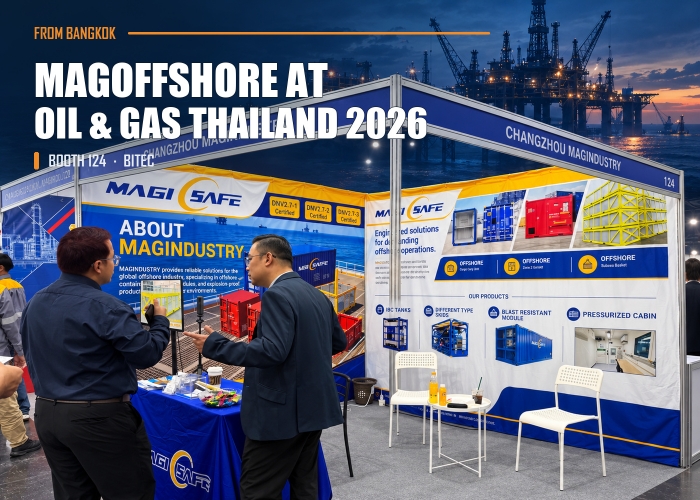 MagOffshore is connecting with energy and offshore professionals at Oil & Gas Thailand 2026 in Bangkok. At Booth 124, the team is presenting offshore cargo carrying units, service modules and engineered solutions while discussing practical project requirements with visitors from across the region.Blog
-
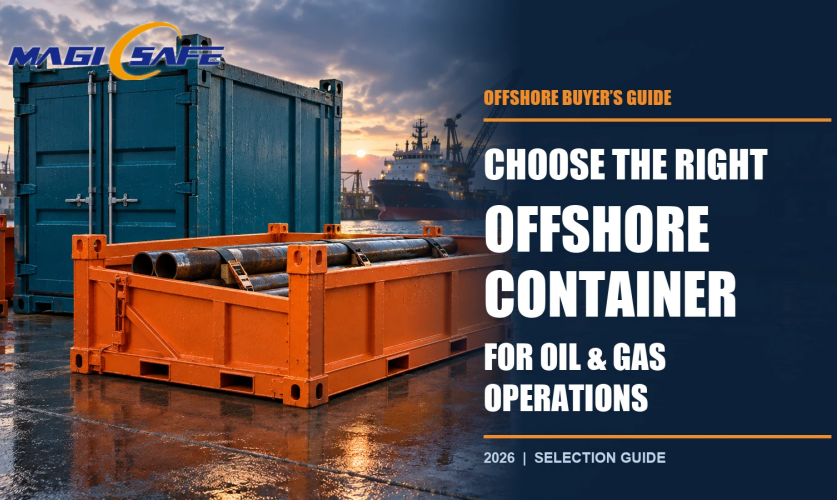 This guide explains how to choose an offshore container based on cargo, loading method, lifting route and certification. It compares common container types and highlights the details buyers should confirm before ordering.News
-
 Compare 10 blast resistant building manufacturers for Qatar projects, with guidance on blast ratings, HVAC, standards and buying requirements.News
