


At a gas processing plant, a control room or operator shelter is part of the operating system. People need a place to monitor equipment, coordinate maintenance and respond to abnormal conditions. Where a facility assessment identifies explosion hazards, the building that houses them needs a defined protective function as well as a practical working layout.
Qatar's LNG operations at Ras Laffan and its offshore gas infrastructure make this a relevant procurement issue for operators and EPC contractors. QatarEnergy LNG's published operations information describes the connections between offshore production, processing trains, storage and export facilities. Each location creates a different brief for personnel buildings and equipment shelters.
For a 2026 purchase, a useful manufacturer comparison starts with the duty of the building. An occupied office, a process control room and an emergency refuge may look similar from outside, yet require different structural performance, air systems and emergency arrangements. Establishing those requirements early makes it easier to compare proposals and avoid expensive changes after fabrication begins.
What Is a Blast Resistant Building?
A blast resistant building, often shortened to BRB, is a structure engineered to meet specified performance criteria under a defined explosion load. When supplied as a transportable factory-built unit, it is also commonly called a blast resistant module, or BRM. The terms overlap; the engineering basis matters more than the label.
Protection involves the building as an assembly: walls, roof, floor, framing, connections, doors, windows where fitted, and service penetrations. A strong wall does little to resolve an inadequately supported door frame or an opening that bypasses the protective envelope.
Typical applications include control rooms, operator shelters, analyzer buildings, electrical rooms, laboratories and security cabins. Emergency refuge is a more specific function. It requires an agreed occupancy, sheltering period and environmental protection strategy in addition to structural resistance.
Blast resistance, fire resistance and Ex protection are different requirements
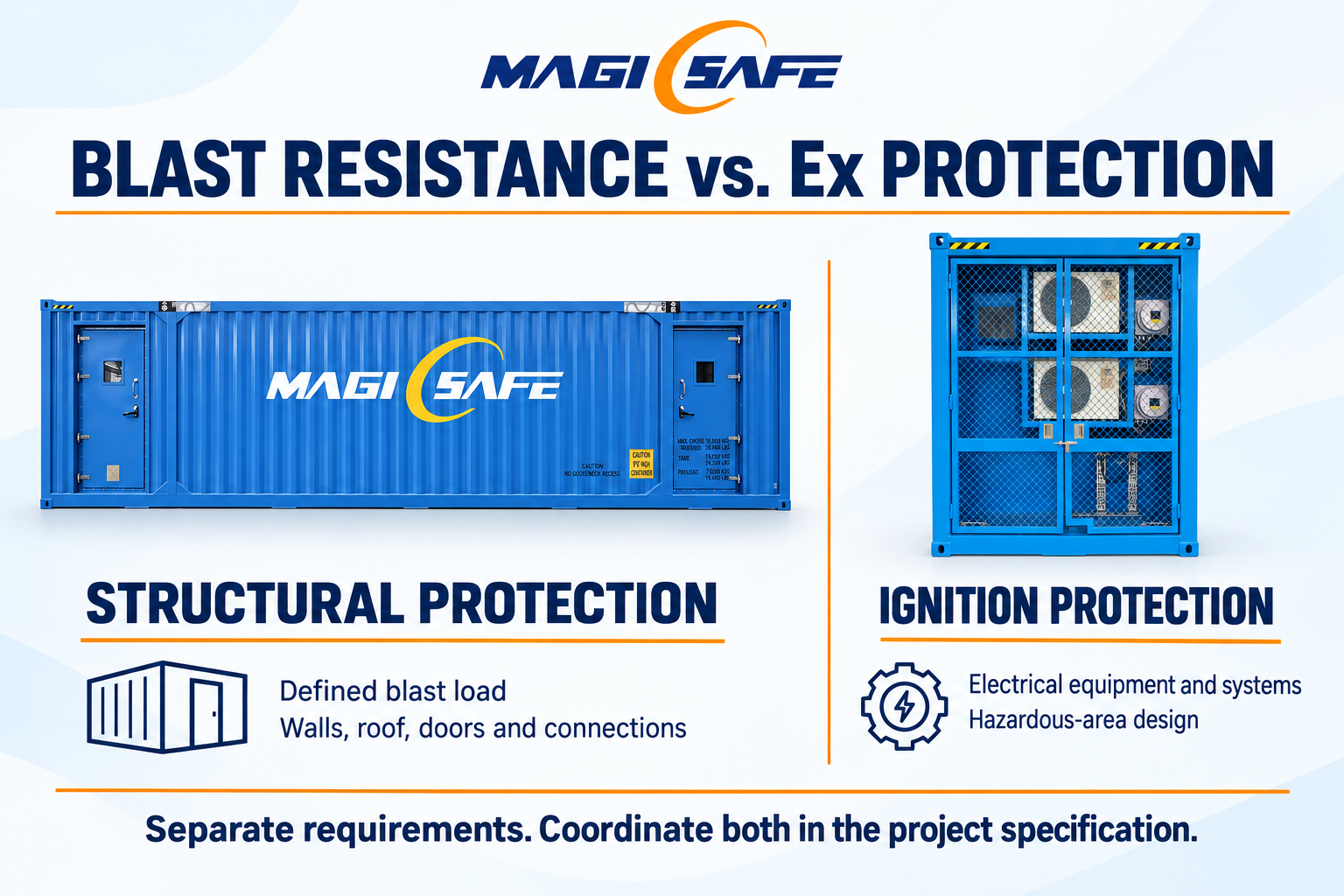
Structural blast resistance and electrical ignition protection require separate specifications.
“Explosion proof building” is a common search phrase, but it is an imprecise specification. In electrical engineering, explosion protection addresses ignition hazards associated with equipment in explosive atmospheres. Structural blast resistance addresses the effects of an explosion on a building. One does not establish the other.
Building or protection type | Main purpose | What the designation does not establish |
|---|---|---|
Ordinary modular office or converted container | Weather protection and usable workspace | Performance under a specified blast load |
Blast resistant building | Structural response to defined explosion loading | Fire endurance, breathable air or electrical suitability for a hazardous area |
Fire-rated building assembly | Performance during a specified fire test or design exposure | Resistance to explosion pressure |
Ex-protected electrical installation | Control of equipment ignition hazards | Blast resistance of the surrounding building |
Pressurized room | Protection strategy using controlled room pressure and associated safeguards | Complete emergency refuge performance |
A project may need several of these functions together. For example, an analyzer shelter can require structural blast protection, suitable electrical equipment and a ventilation strategy addressing potential releases inside the room. Describe each requirement separately, then coordinate the interfaces.
How to Read a Blast Rating Before Comparing Manufacturers
A pressure figure such as 5 psi or 10 psi is only part of a blast specification. The duration and shape of the load, the direction of exposure, and the permitted structural response also affect the design. Two buildings advertised at the same peak pressure may therefore represent different levels of protection.
Design input | What to establish | Why it changes the purchase |
|---|---|---|
Blast pressure | Load definition, including incident or reflected pressure | A reflected face load is not interchangeable with a free-field pressure |
Positive-phase duration | Time over which the positive pressure acts | Duration affects impulse and structural response |
Pressure-time history | Approved load shape and applicable load cases | Peak pressure alone does not describe the complete event |
Response criteria | Permitted deformation and component acceptance limits | Different damage objectives can require different construction |
Orientation and support | Exposed faces, foundations, restraints and anchorage assumptions | The delivered installation must match the analysis |
Occupancy and function | Number of people and required post-event performance | Personnel protection and continued operation are different objectives |
For illustration, a statement of “10 psi at 200 milliseconds” contains more information than “10 psi,” but still needs its loading definition and response criteria. It should not be read as a universal requirement for Qatar. The site's hazard assessment and the owner's design basis determine the required performance.
When a supplier refers to a tested design, ask how the test or supporting analysis applies to the proposed dimensions, door positions and equipment openings. Changing a standard layout can change the structural behavior. The relevant evidence is the evidence that covers the configuration being purchased.
Ten Manufacturers to Consider for a Qatar Project
The following companies are presented in no particular order; this is not a ranking. The comparison focuses on documented building products, engineering scope and the type of project each company can help a buyer evaluate.
Manufacturer | Published capability or project evidence | Useful focus for the enquiry |
|---|---|---|
Hunter Buildings | Blast resistant guard house delivered in Ras Laffan, Qatar | Occupied industrial buildings and integrated site facilities |
MagOffshore | Custom onshore and offshore BRMs; Middle East delivery | Hazardous-area systems and project-specific modular layouts |
Specialist Services | Dubai-based technical and blast building manufacturer | Modular buildings with coordinated electrical and mechanical systems |
Technomak | UAE engineering and manufacturing of blast- and fire-rated technical buildings | E-houses, substations and equipment-intensive modules |
Spacemaker | UAE modular manufacturer with a dedicated BRM range | Standardized building formats and regional fabrication |
Mech-Tool Engineering | Bespoke modular buildings and fire-and-blast protection systems | Complex protective envelopes and integrated technical buildings |
MineARC Systems | ChemSAFE blast resistant buildings and safe-haven systems | Emergency refuge and air-quality requirements |
CID Associates | Engineered-to-order protective modular buildings | Customized industrial enclosures and equipment protection |
Ecotone Systems / Blastotech | Blast resistant modules and joinable building configurations | Office blocks, switch rooms and operator shelters |
Safe Haven Enterprises | US manufacture of industrial BRMs and protective structures | Projects combining industrial protection and security requirements |
1. Hunter Buildings
Hunter provides a particularly useful local reference: its published case study describes a blast resistant guard house completed in Qatar in 2024 at Ras Laffan Industrial City. The steel modular building incorporated HVAC, fire detection, telecommunications and electrical installations.
That combination is relevant when a project needs a functioning occupied building rather than a structural enclosure alone. A guard house also brings access control, visibility and daily staff movement into the design discussion. For a comparable enquiry, use the project as a reference for the delivery scope and request the technical basis applicable to the new site. The case study does not publish a pressure-duration rating that can simply be transferred to another building.
2. MagOffshore
MagOffshore's blast resistant module range covers onshore and offshore energy applications, with options for pressurization, hazardous-area electrical equipment, fire-and-gas systems and custom room arrangements. Its published standard 40-foot model lists 10 psi at 200 milliseconds with an ASCE Medium Response designation; that is a model-specific reference, not a rating for every configuration.
The company has also published a two-module Middle East delivery. Its customization scope includes building dimensions, HVAC, doors, windows and installation arrangements. For Qatar enquiries involving both a protected workspace and integrated services, these are useful starting points. Submit the site design basis with the layout so the proposed assembly and documentation can be reviewed together.

3. Specialist Services
Specialist Services, a Centurion company headquartered in Dubai, manufactures technical and modular buildings for energy applications. Its blast-building range includes office modules, laboratories, workshops and refuge configurations, with published options in different widths and lengths.
Its wider technical-building portfolio includes e-houses, control rooms and local equipment rooms. This makes it relevant where several building packages must share consistent engineering and installation interfaces. A procurement team comparing a personnel module with an electrical enclosure should still issue separate functional requirements: cooling loads, occupancy, access and emergency behavior will differ even when both packages use a similar modular format.
4. Technomak
Technomak approaches the category through integrated technical buildings. The UAE company describes in-house design, engineering, manufacturing, installation and commissioning, including multi-storey blast- and fire-rated modules. Its portfolio also covers substations housing switchgear, UPS systems and battery rooms.
For an EPC contractor buying an e-house or local equipment room, the equipment arrangement can drive the building as strongly as the external hazard. Cable access, maintenance clearances and heat rejection need attention before the structure is frozen. Technomak's published scope makes it a candidate for this type of coordinated package. Separate the structural, fire and electrical requirements in the enquiry rather than treating a technical-building label as a complete specification.
5. Spacemaker
Spacemaker has a dedicated blast resistant module category within its broader modular-building portfolio. Its published locations include a Sharjah factory and offices in Dubai and Abu Dhabi, providing a regional manufacturing option for a Qatar procurement exercise.
The attraction of an established module format is a clearer starting layout and production scope. That can be useful for repeat office or operator-shelter requirements. It is still necessary to check whether the available configuration matches the site's loads and intended occupancy before treating it as a standard purchase. For Qatar delivery, include transport, installation and commissioning responsibilities in the quotation request alongside the building specification.
6. Mech-Tool Engineering
Mech-Tool Engineering offers bespoke modules designed around specified explosion, fire, acoustic, thermal and seismic criteria. Its published manufacturing options include carbon steel, duplex and 316L stainless steel, with electrical, HVAC and monitoring systems available as part of the package.
The company also has Qatar-related protective-system experience: its fire-and-blast brochure identifies a deck-to-deck system supplied for Al-Shaheen. That reference concerns a protective system, not proof of a complete Qatar BRB installation. Its relevance is the engineering of protective interfaces. Mech-Tool merits consideration when a building involves a demanding envelope, unusual material requirements or integration into a larger offshore structure.
7. MineARC Systems
MineARC's ChemSAFE portfolio brings an emergency-refuge perspective to the comparison. Its petrochemical range includes blast resistant buildings, transportable safe havens and shelter-in-place solutions, together with air-quality and life-support products.
This distinction matters when the building must accommodate people during a chemical release as well as resist structural loading. The central questions then include occupancy, sheltering duration, leakage, heat and the behavior of air systems when external air becomes unsafe. MineARC is a relevant manufacturer to evaluate for that duty. A normal working office and an emergency refuge should not be compared solely by floor area or steel thickness; their operational requirements are different.
8. CID Associates
CID Associates manufactures engineered-to-order modular protective buildings. Its published range covers industrial shelters and includes designs addressing blast, fragmentation and other defined threats. The company also describes reinforced openings and integrated equipment within liftable building configurations.
For a Qatar buyer, its relevance is specialized enclosure design, especially where the protection brief extends beyond a routine office module. Keep the threat specification precise: a security-related blast case or ballistic requirement does not automatically establish suitability for a process-plant explosion scenario. The enquiry should identify the required load cases and Qatar delivery scope so that the proposed design is evaluated against the actual industrial duty.
9. Ecotone Systems / Blastotech
Ecotone Systems presents its blast resistant building products through Blastotech. The published range includes 20-foot and 40-foot units that can be joined into larger buildings, with applications such as switch rooms, operator shelters and office blocks. It also describes air-conditioning and ventilation shutdown arrangements, with optional gas detection.
Joined modules deserve particular attention during bid review. The interface between units must preserve the required structural behavior and any specified fire or environmental separation. This manufacturer is worth evaluating where a project needs more space than one transportable unit provides. Request the assembled-building design scope, including interconnections and site completion work, rather than pricing the individual modules in isolation.
10. Safe Haven Enterprises
Safe Haven Enterprises manufactures protective structures in Louisiana, including blast resistant modules for petrochemical applications and systems addressing forced-entry or ballistic threats. Its published building scope includes factory-installed HVAC, electrical, telecommunications and interior fit-out, with interconnecting configurations available.
It offers a different comparison point for buyers whose brief combines industrial protection with specific security requirements. Those functions should remain separate in the technical evaluation so that a certificate for one threat is not used as evidence for another. For an international order, identify the export package, Qatar site support, electrical requirements and acceptance documentation before comparing its price with a regional proposal.
Steel Modular Buildings vs. Reinforced Concrete Buildings
Both steel and reinforced concrete can form part of a blast resistant building design. The appropriate choice depends on the design loads, occupancy, footprint, construction conditions and lifecycle requirements. Material alone does not determine the finished building's performance.
Decision factor | Steel modular construction | Reinforced concrete construction |
|---|---|---|
Delivery approach | A substantial portion of fabrication and fit-out can take place off site | Often involves more site work, although precast options may be available |
Layout and transport | Module dimensions, lifting weight and road access constrain the arrangement | Site construction can accommodate layouts outside transportable dimensions |
Structural design | Connections, plate behavior, openings and restraints need coordinated analysis | Reinforcement, detailing, openings and support conditions need coordinated analysis |
Future relocation | May be practical when the module and connections are designed for it | Generally less straightforward for a building cast in place |
Long-term upkeep | Coatings, seals, doors and exposed connections need planned inspection | Concrete condition, cracking, reinforcement durability and openings need attention |
For a compact equipment shelter, factory integration may carry considerable value. For a large permanent control building, the site layout and overall construction strategy may favor another solution. Compare the complete installed building, including foundations and services, rather than the price of the enclosure alone.
Qatar Project Requirements That Deserve Early Attention
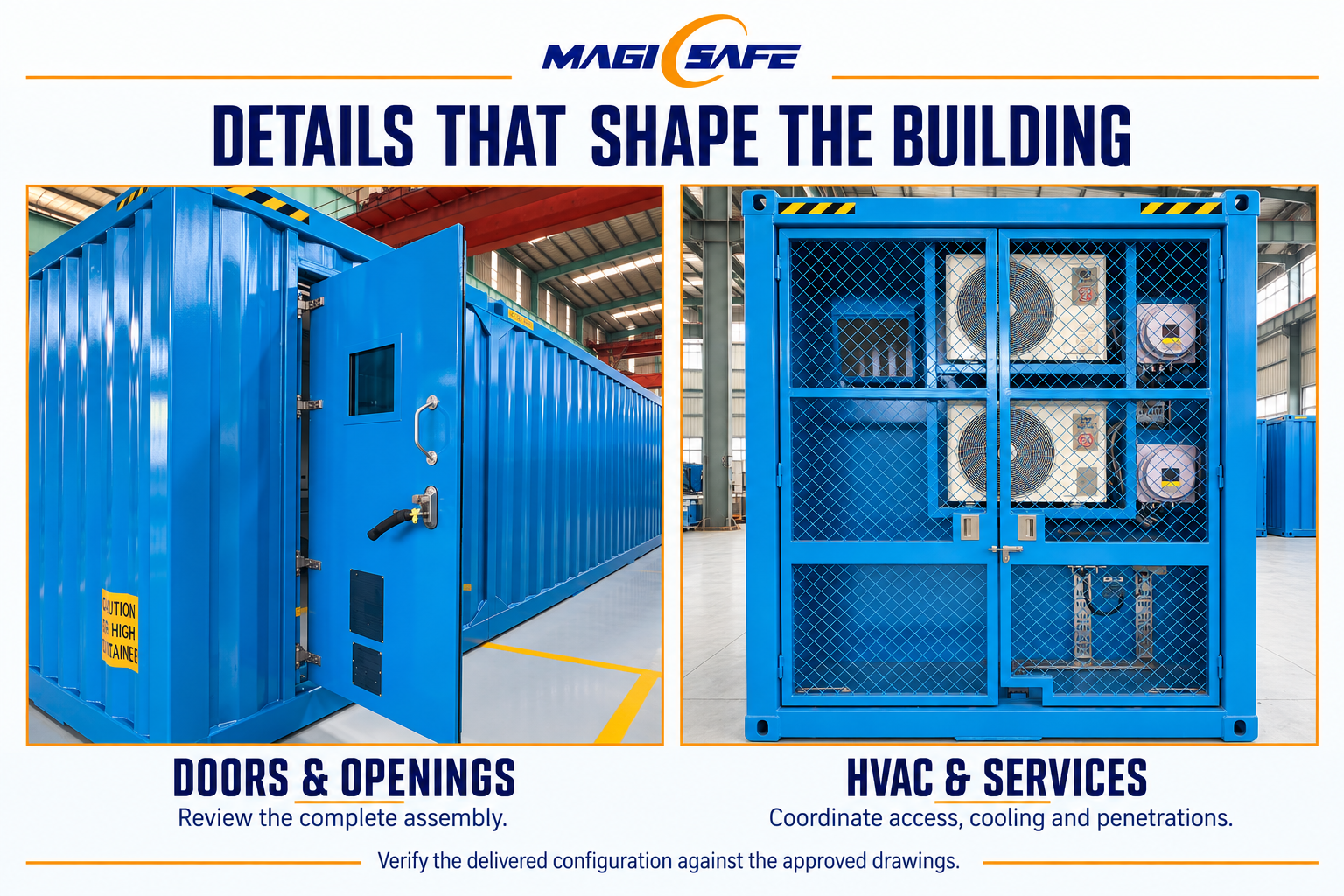
Doors, openings and service systems need to be coordinated with the approved building design.
Cooling, humidity and maintainable equipment access
Specify the project's outdoor design temperature, humidity, solar exposure and dust conditions. An air-conditioning capacity quoted without its operating conditions is difficult to evaluate. Occupants, computers, analyzers and electrical equipment all contribute to the cooling load.
The position of an external equipment bay also matters. Allow working space for maintenance and the airflow needed by the selected equipment. A compact arrangement that looks convenient on a drawing may become difficult to service after the module is placed beside another building. Include the proposed site spacing in the layout review.
Doors, service openings and fire protection
Review each door as an assembly, including leaf, frame, hinges, latches, glazing where fitted and attachment to the structure. Emergency access and exit arrangements must work with the specified protective function.
The same principle applies to cable transits, ducts and pipe penetrations. Their details need to match the relevant blast, fire and environmental requirements. Fire ratings should identify the exposure and acceptance basis. A duration by itself does not make different fire-rating systems equivalent, and the rating of a panel does not establish the rating of the completed room.
Pressurization, gas detection and shutdown behavior
For a pressurized cabin, define how the system establishes pressure, monitors its condition and responds to a fault. Coordinate gas detection, ventilation, alarms and electrical isolation through an agreed cause-and-effect schedule. The required sequence should come from the project safety design, not from assumptions about a standard control panel.
IEC 60079-13 addresses pressurized and artificially ventilated rooms used to protect internal equipment in specified explosive-atmosphere applications. Its scope explicitly does not establish personnel air-quality requirements for toxicity and temperature. Emergency refuge therefore needs a separate, complete habitability basis.
Delivery, foundations and site acceptance
Confirm the final transport dimensions and shipping weight after the equipment list is agreed. Foundations, anchorage, crane access and service connection points should be resolved before the module leaves the factory. The installed restraint arrangement must be consistent with the structural design.
For offshore service, establish the applicable transport and service-module certification route separately from the blast design. DNV-ST-E271 covers offshore containers and lifting sets, including manufacturing and testing requirements; it is not a stand-alone certification of a building's blast performance.
A Qatar purchase order should also name the parties responsible for import arrangements, site delivery, installation, commissioning and owner acceptance. Where authority approvals or operator vendor qualification apply, agree the submission responsibilities during procurement. Generic claims of regional experience should not replace a defined project execution plan.
Which Standards and Documents Should Buyers Review?
API RP 752 and API RP 753 address hazards associated with the location of permanent and portable process-plant buildings respectively. API announced updated editions of both in January 2024. Their focus is hazard management and building siting, including explosion, fire and toxic-release risks. They are not a substitute for a building-specific calculation package.
The project team should determine which practice and edition apply to the intended installation. A structure being transportable does not, by itself, resolve how a long-term occupied installation should be assessed.
The bid and handover documents should connect the design basis to the delivered unit. Request the structural analysis, general arrangement drawings, foundation reactions, opening details, material records and inspection plan. Add the electrical drawings, equipment certification schedule and control philosophy where these systems are included.
Factory acceptance testing should cover the agreed functional scope. Site acceptance then verifies the completed installation and interfaces. Keep design verification, manufacturing inspections and functional tests distinct: a satisfactory air-conditioning test does not verify blast resistance, while a structural calculation does not demonstrate that the alarm sequence works.
What to Include in a Blast Resistant Building RFQ
Issue the same design inputs and delivery scope to each bidder.
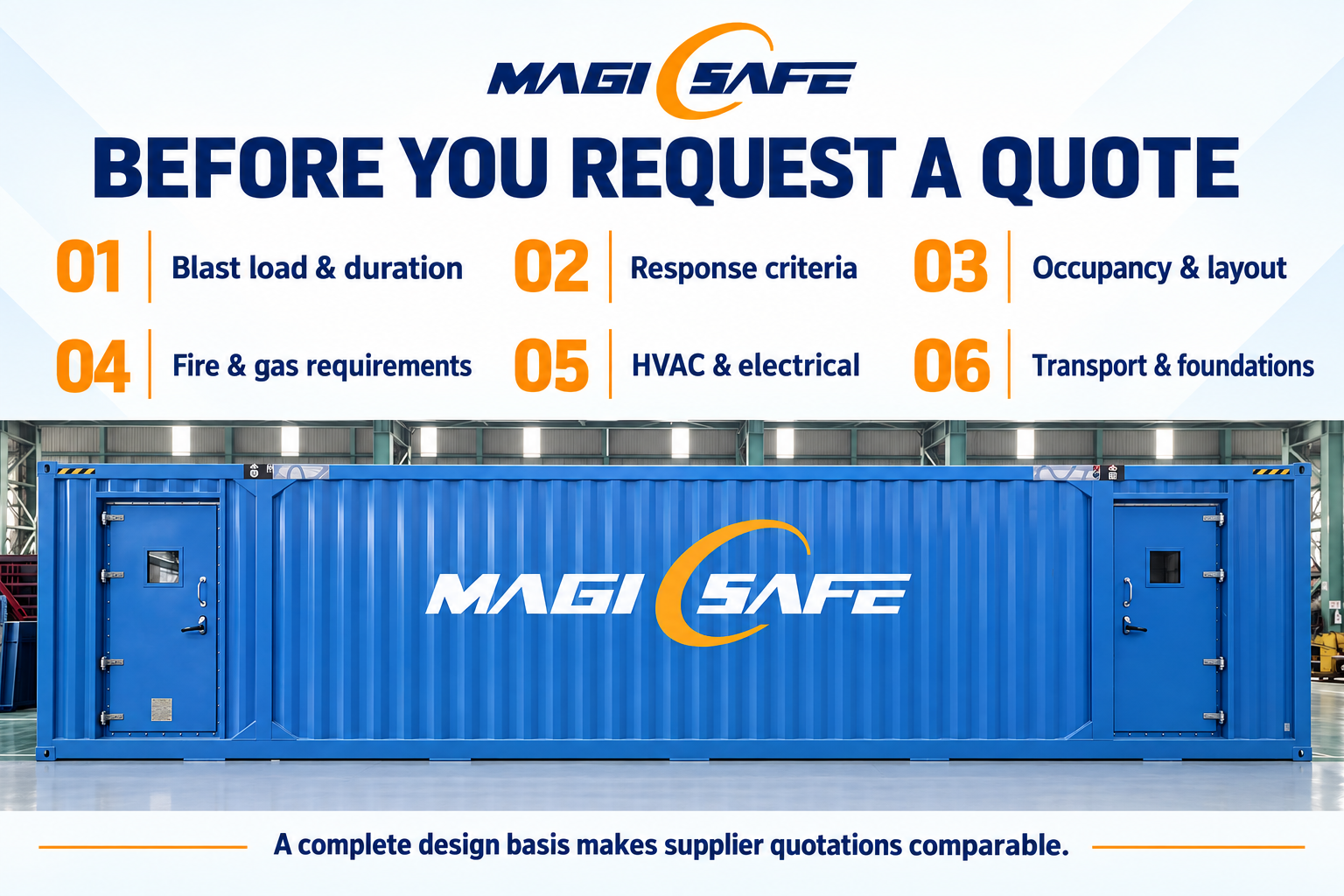
A useful request for quotation gives each manufacturer the same design information and delivery boundary. Include:
Application, site location, expected occupancy and operating hours.
Blast load definition, duration, load cases and required response criteria.
Building dimensions, room arrangement, doors, windows and equipment access.
Fire exposure requirements and hazardous-area classification, where applicable.
Cooling loads, environmental design conditions and pressurization requirements.
Electrical supply, equipment list, communications and fire-and-gas interfaces.
Foundation and anchorage assumptions, lifting requirements and transport limits.
Required design review, inspections, factory tests, site tests and final records.
Delivery destination, installation scope, commissioning support and schedule milestones.
Ask bidders to identify deviations and exclusions explicitly. One quotation may include only a completed module at the factory; another may include delivery, site integration and commissioning. Bringing both offers to the same scope gives the commercial comparison a useful basis.
For a MagOffshore enquiry, send the site design basis together with a room sketch and equipment list through the project contact page. This gives the team enough information to discuss a defined building package, including the systems and records required at handover.
Frequently Asked Questions
What blast pressure is required for a building in Qatar?
There is no single pressure value that can be applied to every site. Use the project's hazard assessment and approved design basis to establish loading and response criteria. Pressure, duration, orientation and support conditions need to be considered together.
Can an ordinary shipping container become a blast resistant office?
A container appearance or reinforced-looking frame does not demonstrate blast resistance. A proposed conversion requires engineering of the complete assembly for the specified load, including openings and supports. Its suitability must be established by the relevant design and verification evidence.
Does a blast resistant building need Ex-rated electrical equipment?
That depends on the area classification and the protection strategy for each location within and around the building. A blast rating does not answer the electrical classification question. Assess internal and external equipment, ventilation and any pressurization system as part of the installation design.
Can the same building serve as an office and an emergency refuge?
It can be designed for both duties, but office comfort provisions alone are insufficient. The refuge brief must define occupancy, duration, air quality, emergency power and the intended response to external hazards. These functions need to be verified as part of the complete system.
What affects price and manufacturing time most?
The protective design basis, building size, equipment content and approval process all influence cost and schedule. Door assemblies, specialized HVAC and electrical packages may also affect procurement. Compare engineering approval, fabrication, testing and delivery milestones separately instead of relying on a single headline lead time.
How should a buyer narrow the manufacturer shortlist?
Start with the building's duty: an occupied workspace, an equipment room or an emergency shelter. Select manufacturers with relevant product evidence, then compare their proposed engineering basis, integration scope and Qatar delivery plan. The strongest proposal is the one that resolves those requirements clearly and can support them with the right documents.
-
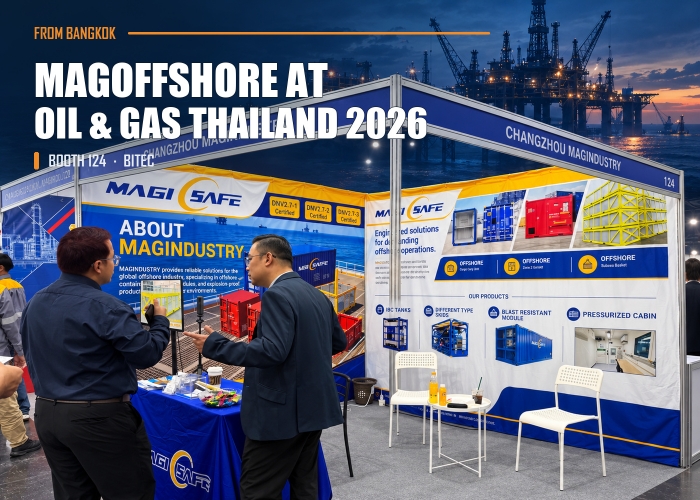 MagOffshore is connecting with energy and offshore professionals at Oil & Gas Thailand 2026 in Bangkok. At Booth 124, the team is presenting offshore cargo carrying units, service modules and engineered solutions while discussing practical project requirements with visitors from across the region.Blog
-
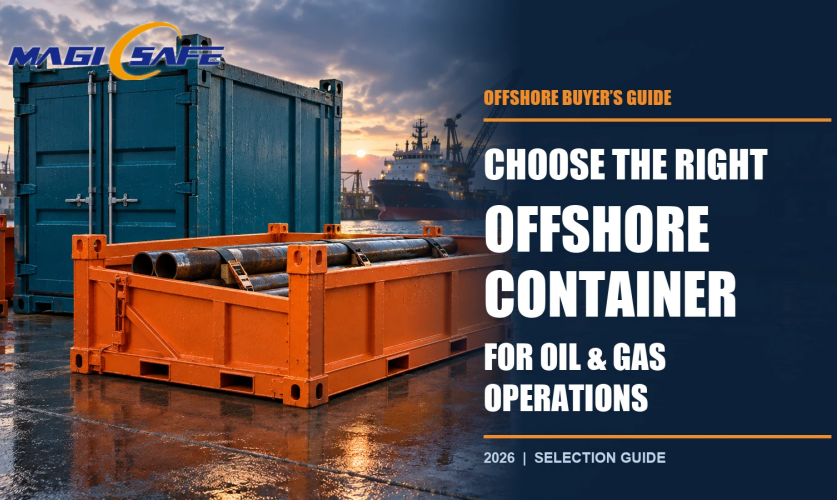 This guide explains how to choose an offshore container based on cargo, loading method, lifting route and certification. It compares common container types and highlights the details buyers should confirm before ordering.News
-
 Compare 10 blast resistant building manufacturers for Qatar projects, with guidance on blast ratings, HVAC, standards and buying requirements.News
