


A chemical producer needs containers that return clean and ready for the next batch. A food processor needs to protect ingredients during storage and transfer. An offshore operator needs a tank that can move safely between a supply vessel and an installation. Across these applications, the choice of bulk liquid container affects far more than how much product can be shipped at once.
Stainless steel intermediate bulk containers occupy a useful middle ground between drums and larger bulk tanks. They combine manageable batch sizes with a durable product-contact vessel, and suitable designs can support repeated cleaning, temperature control, and demanding handling conditions. Their value depends on matching the tank to the liquid and the way it will be used.
For U.S. buyers sourcing stainless steel IBC tanks in 2026, material selection, discharge design, and handling requirements provide a more useful starting point than capacity alone. Understanding these differences also makes it easier to identify a supplier whose products fit the job.
What Counts as a Stainless Steel IBC Tank?
A stainless steel intermediate bulk container is a reusable vessel for storing and handling bulk materials, usually equipped for mechanical movement. For liquid service, the familiar configuration combines a stainless steel body, top filling opening, bottom discharge valve, and a base suitable for a forklift or pallet jack.
This article focuses on liquid stainless steel IBC tanks and tote tanks. A plastic bottle inside a metal cage is a composite IBC, not a stainless steel tank. Powder bins, stationary process vessels, and larger ISO tank containers also serve different duties.
Transport approval, sanitary design, and offshore lifting capability are separate requirements. A container can be suitable for one without being suitable for the others. Establish the intended duty before comparing specifications or prices.
Stainless Steel vs. Plastic IBC Tanks: What Changes in Practice?
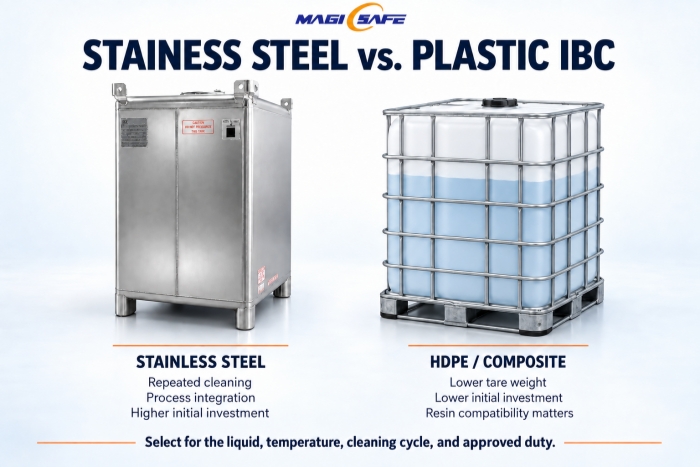
Most familiar caged plastic IBCs use a high-density polyethylene (HDPE) inner bottle supported by a metal cage and pallet. A stainless steel IBC has a metal product-contact vessel. The cage on a plastic IBC protects and supports the bottle; it does not give the bottle the temperature or barrier properties of stainless steel.
Purchasing factor | Stainless steel IBC | HDPE or composite IBC |
|---|---|---|
Initial investment and weight | Generally higher purchase cost and empty weight | Generally lower purchase cost and lighter handling weight |
Chemical compatibility | Depends on alloy, liquid concentration, temperature, and seals | Depends on resin, liquid concentration, temperature, and seals; plastic can suit chemicals that attack stainless steel |
Heat and cleaning | Suitable designs accommodate more demanding thermal cycles and repeated cleaning | Allowable temperatures depend on the specific bottle and assembly; thermal limits need particular attention |
Product protection | Metal shell provides a barrier to light and permeation through the vessel wall | Light transmission and permeation depend on the liquid, bottle construction, and any barrier treatment |
Reuse and maintenance | A serviceable vessel can support repeated use, inspection, and qualified repair | Reuse, reconditioning, or bottle replacement depends on the design and previous contents |
Choose according to the operating cycle. A compatible plastic IBC can be an economical option for ambient-temperature distribution. Stainless steel becomes more attractive when the tank circulates repeatedly through a controlled process, undergoes demanding cleaning, or needs integrated heating and other process features.
Neither material automatically makes a container suitable for food or hazardous chemicals. Food-contact suitability involves all wetted components and the cleaning process. Hazardous-liquid service also requires the appropriate packaging design and authorization. Where flammable liquids are involved, assess the complete container and installation; a metal shell alone is not a fire-safety approval.
Carbon steel IBCs provide another option where the product is compatible with the steel or a specified lining. If a lining is required, its condition and resistance to cleaning become part of the maintenance plan. Stainless steel may avoid that particular lining requirement, but it still needs a corrosion assessment for the intended liquid.
SS304 vs. SS316: How to Choose the Tank Material
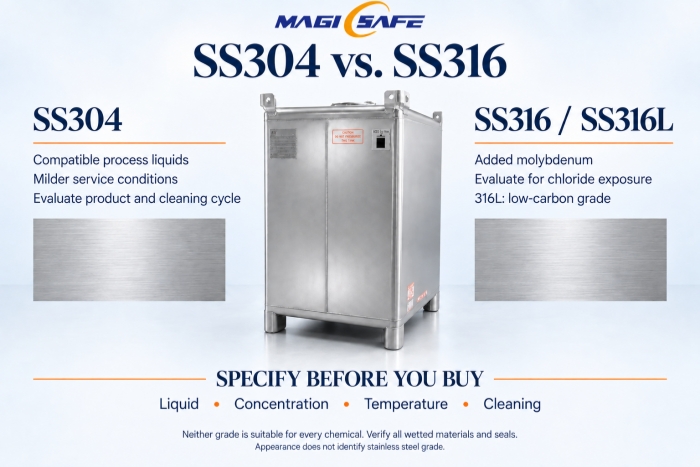
SS304 is a common starting point for compatible food ingredients, industrial liquids, and relatively mild service conditions. SS316 contains molybdenum, which improves resistance to localized corrosion in many chloride-containing environments. That additional resistance can be useful, but the upgrade should answer a specific exposure requirement.
Service condition | Selection approach |
|---|---|
Compatible liquid, modest temperature, controlled indoor use | Evaluate SS304 first; extra alloy content may provide little practical benefit |
Chlorides, salt exposure, or more aggressive process conditions | Evaluate SS316 or SS316L against the actual concentration and temperature |
Frequent cleaning with changing chemicals or elevated temperatures | Check both the product and the full cleaning cycle before choosing the grade |
Severe acidity, high chlorides, or hot corrosive service | Do not assume SS316 is sufficient; obtain a specific materials assessment |
The “L” in 304L and 316L means low carbon. It improves resistance to intergranular corrosion associated with welding under relevant conditions; it does not make the alloy immune to chemical attack.
In practice, send the supplier the liquid composition, concentration, operating temperature, and cleaning procedure. Specify the wetted valves and fittings as well as the tank shell. A 316L vessel fitted with unsuitable seals can still fail at the connection, while a well-specified 304 tank may serve a compatible process without needing an upgrade.
Standard SS IBC vs. DNV Offshore Stainless Steel Tank
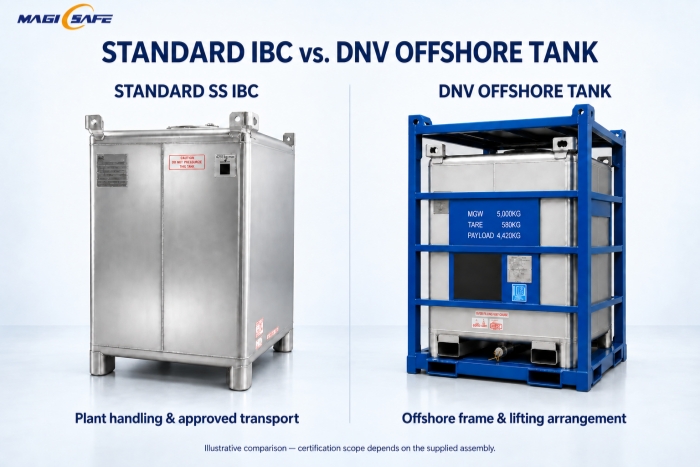
“SS IBC” describes a stainless steel intermediate bulk container. In this context, a “DNV offshore stainless steel tank” means a tank assembly with offshore handling certification, commonly associated with DNV 2.7-1. These descriptions can overlap: a stainless steel IBC can form part of a certified offshore assembly.
The distinction is the handling duty and certification scope, not simply the stainless steel grade. DNV-ST-E271 addresses offshore containers and lifting sets, including manufacturing, testing, marking, and inspection requirements.
Comparison | Standard stainless steel IBC | DNV-certified offshore tank assembly |
|---|---|---|
Typical duty | Plant handling, storage, and approved transport | Offshore transfers and handling within its certified scope |
Structure and handling | Base and lifting provisions defined by the IBC design | Offshore structural and lifting arrangement covered by certification |
Documentation | Product specification and applicable transport records | Offshore certification and inspection records, plus applicable tank transport documents |
Selection basis | Liquid compatibility, payload, drainage, and transport duty | Those requirements plus offshore handling and project acceptance |
An IBC's UN transport marking does not establish offshore lifting approval. Equally, an offshore frame certificate does not by itself authorize the liquid as dangerous-goods cargo. Specify both scopes when the job requires them, and check which components and assembly the documentation covers.
For a tank moving only between a warehouse and a production line, offshore certification may add no useful capability. For vessel-to-installation transfers, discuss the complete tank, protective structure, and lifting arrangement from the beginning. Adding lifting lugs to a standard tote does not create a DNV-certified offshore tank.
Top Stainless Steel IBC Tank Manufacturers in USA
Custom Metalcraft
Custom Metalcraft manufactures stainless steel equipment in Springfield, Missouri, including its TranStore intermediate bulk containers. Its published options include different stainless steel grades, manways, valve arrangements, fittings, and heating or cooling jackets.
That range is useful when a tote does more than carry liquid from one building to another. A beverage ingredient may need temperature control before discharge; a coating may leave costly residue in an unsuitable outlet arrangement. The container geometry and accessories then become part of the production decision.
Custom Metalcraft is a relevant starting point for buyers seeking U.S. fabrication with scope to adapt an established tank design. Evaluate the quoted transport IBC separately from its fermentation and process tank offerings, particularly where the same operation uses several vessel types.
MagOffshore — Stainless Steel IBCs for Offshore Chemical Handling
MagOffshore's offshore stainless steel IBC tank range addresses liquid handling in marine, offshore oil and gas, and industrial projects. Its published configurations include 350- and 550-gallon capacities, SS304 or SS316 construction, and an offshore protective frame. Listed customization options include SS316L, valves, fittings, and identification details.

For an offshore project, the tank and its handling arrangement need to be considered together. Forklift access, valve protection, lifting arrangements, and the complete assembly's documentation affect how the equipment moves from a shore base to its destination.
MagOffshore's product page references DNV 2.7-1 frame certification, UN 31A/Y approval, and IMDG requirements. These should be matched to the exact configuration offered and the project's acceptance requirements. An enquiry should define the liquid, working capacity, lifting arrangement, and required documentation so the tank and frame can be evaluated as one package.
Snyder Industries
Snyder Industries offers several steel IBC families, including LiquiTote stainless steel tanks. The published LiquiTote range includes 350-, 550-, and 793-gallon nominal sizes, as well as custom sizing.
For a chemical producer operating a returnable fleet, consistency can matter as much as individual tank features. Common outlet positions, closure hardware, and handling dimensions make it easier to organize filling, unloading, and maintenance across multiple locations. Snyder's range provides a basis for that standardization exercise.
Compare the actual product families rather than treating every Snyder steel tote as interchangeable. Carbon steel, stainless steel, and double-wall designs serve different requirements. The useful specification is the one that identifies the selected vessel, its materials, and its permitted service.
American Machining
American Machining, Inc., also known as The IBC Resource, manufactures standard and customized IBC totes. Its container page lists capacities from 120 to 793 gallons and stainless steel options in 304 and 316. Published features include a sloped bottom and alternative base dimensions.
This is a useful company to consider when the difficulty lies in the connection between an IBC and existing equipment. A receiving station may restrict the footprint, or a transfer line may require a different fitting arrangement. Starting with those constraints gives the fabricator something more useful than a request for a generic tank capacity.
American Machining's product offering also includes container accessories and replacement parts. For buyers maintaining an existing tote fleet, compatibility with installed hardware deserves attention alongside the specification for new units.
Sharpsville Container
Sharpsville Container fabricates stainless steel containers and pressure vessels in Pennsylvania. Its hazardous-material transportation literature specifically includes IBCs, totes, and UN/DOT portable tanks, with options for specialized inlet and outlet configurations and forklift handling.
Its relevance is strongest when a standard catalogue tote leaves an engineering question unresolved. The liquid, transfer method, or operating conditions may call for a purpose-designed vessel rather than a change of valve on an otherwise standard tank.
Keep the equipment category explicit in the enquiry. An IBC, a UN portable tank, and a pressure vessel are not interchangeable descriptions, even when one manufacturer builds all three. Sharpsville's broader fabrication scope makes that distinction particularly useful during early technical discussions.
Titan IBC
Titan IBC operates from Beatrice, Nebraska, and offers stainless steel totes, custom IBC solutions, and parts. Its published range describes 304 or 316 stainless steel construction, with choices for valves, covers, clamp rings, gaskets, and other fittings.
Those details become noticeable during daily use. A valve that is awkward to reach slows unloading; a closure that requires unfamiliar parts complicates maintenance. Buyers replacing or expanding a fleet can use Titan's hardware range to compare how a proposed tote will work with existing hoses, filling equipment, and spare parts.
Titan also markets separate wine and beverage tanks. Choose from the product line appropriate to the duty: a beverage storage configuration should not be assumed to carry the same transport approval as a hazardous-liquid IBC.
THIELMANN
THIELMANN manufactures stainless steel industrial containers, including aseptic IBCs, and lists a U.S. business location in Franklin, Tennessee. Its portfolio spans food, beverage, chemical, and pharmaceutical applications.
An aseptic container enquiry begins with the product and cleaning process. The manufacturer needs to know how the vessel will be filled, emptied, cleaned, and sterilized, and which connections must integrate with the production line. Capacity alone provides very little of that information.
THIELMANN is therefore relevant where hygienic handling or specialized container design drives the purchase. Discuss the particular IBC model, product-contact fittings, and documentation package through its U.S. contact, with cleaning and sterilization conditions included in the specification.
SCHÄFER Container Systems
SCHÄFER Container Systems manufactures stainless steel liquid IBCs alongside heated, aseptic, and customized containers. Its industrial range includes BTA tank containers and RCN round containers, with process options such as heating systems, agitators, and custom connections.
These options matter when material must remain workable between filling and discharge. A temperature-sensitive ingredient or viscous process liquid may require more than passive storage. Heating duty, mixing requirements, and discharge geometry should be discussed as a connected system.
For an integrated container, include the receiving equipment layout and utility requirements in the first technical exchange. This gives SCHÄFER's engineering team a basis for discussing how the vessel will connect to the filling, heating, and discharge stages of the process.
The Cary Company
The Cary Company supplies stainless steel IBCs through its industrial packaging catalogue, including UN-rated transport tanks and separate sanitary-grade configurations. Published products include 350- and 550-gallon stainless steel units.
A distributor can be a practical purchasing route when the specification already fits a catalogue product. The buyer can compare individual part numbers, connection details, and accessory requirements before placing an order, rather than starting a custom fabrication discussion.
The Cary Company should be evaluated as a supplier, not counted as an additional tank factory. Request the original manufacturer's documentation with the selected unit, and keep transport and sanitary models distinct. Similar capacity and appearance do not establish identical approvals or product-contact fittings.
Metano
Metano supplies stainless steel IBC tanks and provides associated services. Its product range includes the Metercube, a 1,000-liter stainless steel IBC with published AISI 304 construction, PTFE seals, and a sloped central discharge arrangement.
The metric format offers a useful comparison for companies working with 1,000-liter batches or international packaging systems. A U.S. gallon-based tote may suit a domestic process perfectly, while a metric container may align more closely with another filling or delivery requirement.
Metano is relevant to buyers comparing those formats for a new container purchase. Assess working volume, footprint, handling interfaces, and replacement components together. A nominal capacity match does not establish that two containers will fit the same production station.
How to Select a Stainless Steel IBC Tank for U.S. Operations
Specify Working Volume, Payload, and Discharge
A 350-U.S.-gallon IBC holds approximately 1,325 liters by volume; 550 U.S. gallons is approximately 2,082 liters. Working fill volume may be lower because of filling limits, expansion allowance, or process requirements.
Weight deserves a separate calculation. For example, 1,000 liters of liquid at 1.4 kg/L weighs 1,400 kg before adding the empty container. Check that against the selected IBC's gross mass rating and the lifting equipment's capacity.
Then examine what happens at the bottom of the tank. Outlet height, valve access, hose routing, and the liquid's viscosity affect drainage. Ask for drawings showing the discharge arrangement, especially where residual product is expensive or difficult to clean.
Plan Inspection, Cleaning, and Parts Before Delivery
For applicable UN IBCs in U.S. hazardous-material transport, 49 CFR 180.352 sets periodic testing and inspection requirements. These include 2.5-year leakproofness testing and external inspection for relevant liquid IBCs, and internal inspection at least every five years. The regulation also addresses records and repairs.
Build these activities into the purchasing decision. Identify where the tanks will be cleaned, who will handle testing, and which replacement components must be stocked. For sanitary service, define cleaning acceptance criteria and access to product-contact surfaces rather than relying on the phrase “food-grade stainless steel.”
What to Include in Your Request for Quotation
A useful RFQ lets each supplier quote against the same operating conditions. Include:
Product: liquid name, safety data sheet, concentration, density, viscosity, and temperature range.
Duty: storage, transport, processing, or offshore handling; identify any hazardous-material requirements.
Capacity and handling: working volume, maximum filled weight, footprint limits, forklift access, and stacking conditions.
Wetted materials: tank grade, valve and seal requirements, finish, and cleaning method.
Connections and options: inlet, outlet, venting, heating, mixing, and any pressure or vacuum requirements.
Documentation: drawings, material records, applicable approval evidence, test records, and operating instructions.
Commercial scope: quantity, U.S. destination, required delivery date, warranty, spare parts, and service responsibilities.
For overseas supply, ask for a delivered-cost breakdown covering freight, import-related charges, and inland delivery. Establish who handles each stage. For domestic supply, confirm actual availability of the selected model; a U.S. address does not guarantee immediate stock.
Frequently Asked Questions
Does a stainless steel IBC need to be DNV-certified?
Not for every application. A tank used for factory storage or road transport is selected against its own operating and transport requirements. DNV offshore certification becomes relevant when the project specifies it for offshore handling. Stainless steel construction alone does not establish offshore lifting suitability.
Is a 316L stainless steel IBC always better than 304?
No. The appropriate grade depends on the liquid, temperature, cleaning chemicals, and fabrication requirements. Specify the service conditions first, then select the metal and seals. Upgrading the tank body alone may not resolve a compatibility problem elsewhere in the assembly.
Can a standard IBC be used as a pressure vessel?
Do not assume so. A transport test pressure or relief-device setting does not establish permission for continuous pressurized operation. If the process involves pressure discharge, vacuum, or steam sterilization, specify it at the outset and obtain a vessel designed for that duty.
What affects the purchase price of a stainless steel IBC?
Capacity, stainless steel grade, surface finish, valve configuration, and approval requirements all influence the specification and quoted price. Heating jackets, mixing equipment, and offshore frames can change the scope substantially. Compare quotations for the same configuration and delivered destination, including documentation, spare parts, and warranty coverage.
Turn the Shortlist into a Workable Specification
Start with the requirement that is hardest to change: the liquid chemistry, the receiving station, the sanitary process, or the offshore lift. Use that requirement to narrow the supplier list before requesting prices.
For an offshore chemical tank project, contact MagOffshore with the liquid details, required capacity, handling arrangement, destination, and documentation requirements. A clearly defined enquiry gives the manufacturer a basis for proposing the tank, fittings, and offshore frame as a complete package.
-
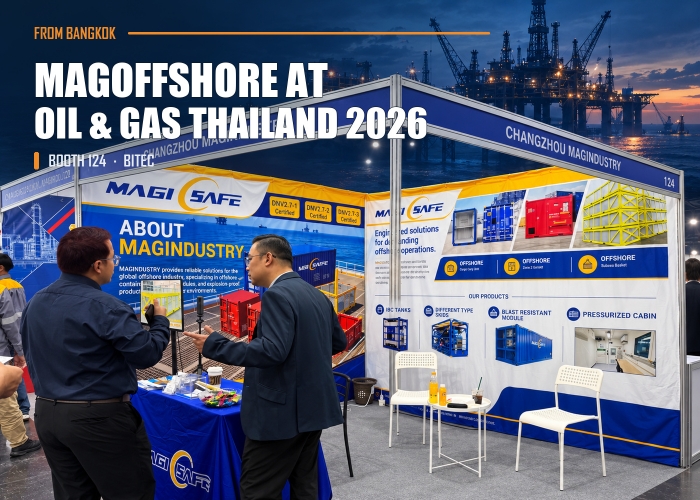 MagOffshore is connecting with energy and offshore professionals at Oil & Gas Thailand 2026 in Bangkok. At Booth 124, the team is presenting offshore cargo carrying units, service modules and engineered solutions while discussing practical project requirements with visitors from across the region.Blog
-
 This guide explains how to choose an offshore container based on cargo, loading method, lifting route and certification. It compares common container types and highlights the details buyers should confirm before ordering.News
-
 Compare 10 blast resistant building manufacturers for Qatar projects, with guidance on blast ratings, HVAC, standards and buying requirements.News
