



Australia’s offshore oil, gas and emerging carbon-storage projects rely on certified containers to move tools, spare parts, provisions and specialist equipment between shore bases, supply vessels and offshore installations. Buyers can source these units from established Australian rental fleets, local container specialists or international manufacturers that build custom equipment for delivery into Australia.
The right supplier depends on the job. This article compares ten companies serving the Australian market in 2026. Some operate facilities or sales teams in Australia; others manufacture overseas and supply Australian projects by export.
What is a DNV offshore container?
An offshore container is a purpose-built cargo unit for repeated lifting in open-sea operations. Unlike a conventional freight container, it may be transferred by crane between a moving vessel and an offshore installation, where impacts, sling forces and uneven handling have to be considered in the approved design.
DNV-ST-E271, commonly known as DNV 2.7-1, covers the design, manufacture, testing, marking and inspection of offshore containers and their lifting sets. DNV lists the March 2023 edition, amended December 2024, on its standard overview. A CSC plate used for international freight transport does not by itself demonstrate that a container is approved for offshore lifting.
Before comparing manufacturers, buyers should first match the container format to the cargo or task.
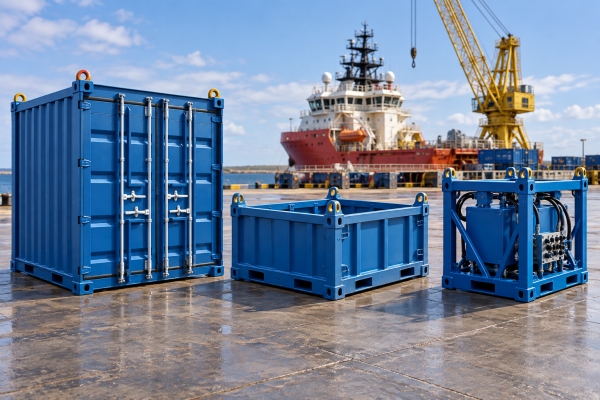
Cargo configurations and selection priorities
Cargo or task | Suitable starting configuration | Selection issue that matters |
|---|---|---|
Boxed spares and maintenance consumables | Closed dry-goods container | Door opening, securing points and usable floor area |
Dense tools, chains and compact steel components | Half-height container | Concentrated floor loads and access for loading from above |
Long tools or assemblies | Cargo basket | Support positions, restraint layout and centre of gravity |
Machinery loaded by crane | Open-top or removable-roof container | Clear loading envelope and roof-handling arrangements |
Chilled or frozen provisions | Offshore reefer | Air circulation, power interface and cargo temperature duty |
Equipment operating on the installation | Workshop or functional module | Structural transport approval plus installed-system requirements |
A basket intended to carry equipment offshore is not automatically suitable for subsea immersion. Likewise, an ordinary shipping container with a CSC plate is not evidence of approval for offshore lifting.
Top 10 Australian offshore container manufacturers
1. OEG
OEG has cargo-logistics facilities listed in Perth, Broome, Darwin and Karratha. Its Australian offering spans dry-goods containers, baskets, half heights, reefers and waste units. For a campaign using several cargo formats, that combination provides a basis for coordinating the rental package, mobilisation and return plan.
There is also specific Australian engineering evidence. OEG reports supplying a customised 20ft laboratory module for a carbon capture and storage project in North-West Australia. It managed design, manufacture and electrical fit-out, incorporating climate control, fume extraction and emergency egress; the case study reports DNV 2.7-1 certification.
This makes OEG relevant to projects combining temporary equipment with offshore operating requirements. The laboratory case demonstrates a particular delivered scope, not identical capability or certification across every rental unit. For routine cargo, its distinguishing value is regional equipment support; for functional modules, it is the ability to manage a complete package.
2. Suretank
Suretank’s manufacturing range includes closed containers, open tops, half heights, baskets, skips, workshops and reefers. Its descriptions identify how those products can change: side or personnel doors, different basket access arrangements, tool supports and workshop services.
Its dry-goods range specifies internal lashing points, external tag-line points and a three-coat offshore paint system with a nominal dry-film thickness of 285 microns. These details create a basis for comparing access, cargo control and coating scope, rather than simply comparing container dimensions.
Suretank also distinguishes its DNV 2.7-1 designs from heavier units for which it describes a DNV 2.7-3 route. Buyers developing an unusually heavy equipment package should resolve the applicable category at concept stage. Treat Suretank as an overseas manufacturing option, with Australian delivery and support included explicitly in the commercial scope.
3. MagOffshore
MagOffshore’s offshore container covers 6ft to 40ft sizes and offers different doors, shelving, tool racks, lashing points and lifting arrangements. Its relevance is strongest where the cargo layout needs to influence the container specification.
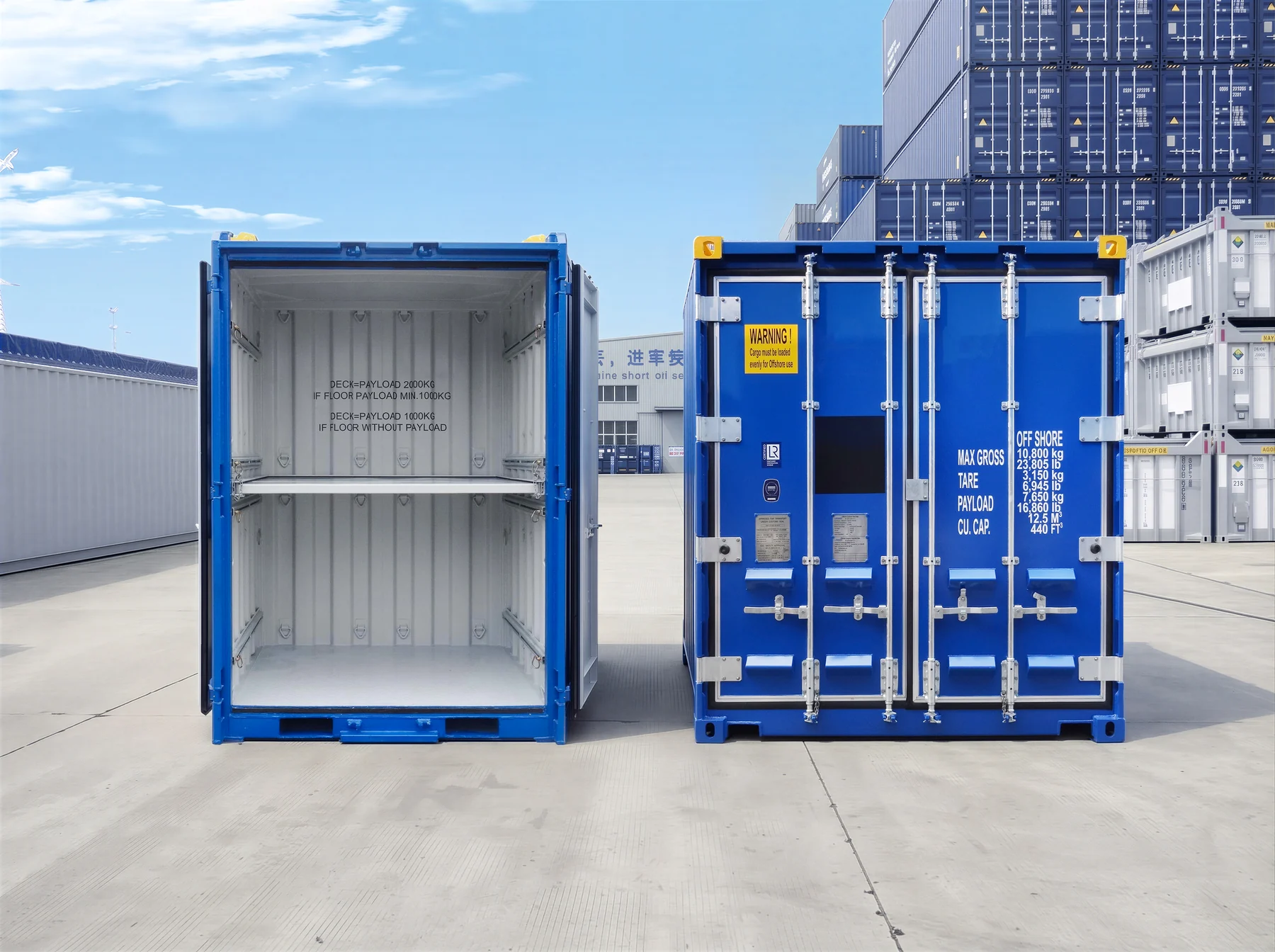
Consider a maintenance package containing a heavy tool assembly, spare parts and frequently used instruments. A single undivided space may leave the assembly difficult to secure and bury the instruments behind other cargo. The useful design discussion is about separating access, locating restraints and allocating shelf loads while keeping the loaded centre of gravity within the approved arrangement.
4. BSL Oilfield Services
BSL lists Perth and Melbourne contacts and markets CCUs, or cargo carrying units, to DNV 2.7-1 and ISO 10855. Its range extends beyond closed containers to drum baskets, bottle racks, half heights, waste skips and rigging lofts.
That matters when a campaign’s manifest contains incompatible cargo formats. Cylinders need a suitable rack; drums need their own securing arrangement; lifting accessories benefit from organised storage rather than being mixed with general spares. Selecting the right unit for each load can reduce repacking and unnecessary handling.
BSL’s Australian contacts and wider Asia-Pacific network make it a candidate for this mixed-equipment requirement. Evaluate the available combination of units and the dispatch plan as a package. An Australian stock-location listing supports a supply route, but the actual unit allocation determines whether that route suits the mobilisation date.
5. TLS Offshore Containers
TLS manufactures offshore containers and names Australia among its target markets. Its functional-container offering covers workshops, laboratories and equipment spaces, with options including air conditioning, extraction, electrical distribution, communications and fire-and-gas detection.
The engineering issue is the interaction between those systems. Equipment heat release influences cooling duty; extraction affects the air balance; maintenance access competes with equipment footprint. A container that is adequate for transporting a machine may be unsuitable for operating it with the doors closed.
TLS is consequently worth considering when the requirement is an operating enclosure rather than cargo storage. Provide equipment heat loads, electrical loads and the intended area classification alongside the structural brief. Its standards references are project-dependent: offshore transport certification and the suitability of the installed systems are separate parts of the delivered solution.
6. Total Containers
Total Containers offers offshore containers and baskets for rental or sale, together with custom builds, modifications, repairs and inspection support. Its offshore page identifies manufacturing records, load-test documentation and certified lifting slings, and describes a Western Australian supply relationship through Sea Containers WA.
The distinctive application is equipment that will evolve between campaigns: a storage unit fitted with shelves, then reorganised as a rigging loft or maintenance workspace. The commercial benefit is having a supplier able to discuss both the initial fit-out and subsequent workshop work.
Engineering control remains central to such changes. A new rack affects tare weight; a welded support introduces a local load path; an opening can affect the enclosure. Modification scope should therefore include the resulting drawings and certification review where applicable. The company advertises factory-built custom units, but the manufacturing location should be identified separately from its Australian supply presence.
7. 271 Containers
271 Containers advertises Australian-market supply through a Perth-focused page. Its brochure describes both offshore CCU rental and the manufacture and sale of offshore modules, making it relevant where cargo equipment and temporary facilities are being sourced together.
The brochure includes closed containers, half heights, baskets and workshops with optional fit-outs. One listed 10ft full-height cargo design has a 2,365kg tare, 7,750kg payload and 10,115kg maximum gross weight. Those figures illustrate why container length alone is insufficient for comparing lifting capacity; they are a catalogue example, not a universal 10ft rating.
For a bespoke requirement, 271’s design offering is the stronger reason for inclusion than the existence of a Perth webpage. The supply is an overseas route unless local dispatch is established in the offer. Its brochure also references different certification bodies for different equipment, so the issuing body belongs in the agreed specification.
8. Tradecorp
Tradecorp’s offshore offering includes mini containers, half heights, baskets, bottle racks and removable-roof designs, and explicitly addresses the Australian market. It describes a 20ft hard-open-top configuration with a removable steel roof and swing header at the rear doors.
This arrangement addresses a practical problem: machinery may fit within the container but be impossible to load through its end doors. Loading from above can accommodate the equipment, while a removable roof provides a different closure arrangement from a permanently open basket.
The complete handling method still needs to account for removing and storing the roof, accessing lifting points on the cargo and securing the machine after loading. Tradecorp is a relevant enquiry when these access details drive the purchase. Its product variety supports that assessment; a specific proposed design and certification package should define the final order.
9. Climatight Containers
Climatight publishes separate specifications for its 10ft and 20ft offshore reefers and offers Australian hire and purchase. Its listed payloads are 7,900kg and 9,820kg respectively, with tare weights of 2,900kg and 4,380kg. Both are advertised against DNV 2.7-1 and EN 12079.
The comparison is revealing: doubling the nominal length does not double payload. The 20ft unit adds 1,920kg of listed payload, approximately 24%, while taking roughly twice the external floor footprint. It may still be the better choice for bulky provisions, but not purely because it is longer.
Its electrical listing specifies three-phase power at 380/460V and 50/60Hz. For selection, match the actual unit’s connection and temperature duty to the installation. An advertised temperature range is not a cooling-capacity guarantee under every ambient condition or door-opening pattern.
10. CBOX Containers Australia
CBOX’s Australian catalogue lists a 20ft high-cube offshore container with DNV 2.7-1/EN 12079 references and CSC certification. The published dimensions distinguish an external height of 2,896mm from a door-opening height of 2,558mm.
For a tall item, that difference is decisive. A rigid 2,600mm-high assembly cannot pass upright through the stated door opening, even though it is shorter than the container’s external height. The loading method, packaging and clearance must be resolved before the extra volume has any value.
CBOX is therefore a specific sourcing option for high-cube cargo, rather than a general recommendation for every offshore configuration. Its page contains differing capacity and weight figures in separate sections; use the approved drawing and unit plate for those values. The consistent dimensional information is useful for preliminary screening, not final lifting approval.
What separates an engineered container from a catalogue match?
The frame must provide a continuous load path
The cargo load has to travel through its supports and the container structure into the lifting set. ISO 10855-1 identifies the essential primary structure as the members forming this path, including rails, posts and pad eyes. Wall and roof panels have a different structural role. This explains why adding lifting eyes to a shipping container is not, by itself, an offshore conversion: the connecting structure must be assessed as a complete system.
For equipment packages, the design must account for where the machine actually bears on the floor. A broad skid and four small mounting feet distribute the same total mass differently. The manufacturer needs the support geometry to design the local structure; increasing the advertised gross weight alone does not resolve that problem.
Manufacturing quality depends on controlled joints, not appearance
Weld quality cannot be judged from a finished coat of paint. The welding procedure defines the materials, consumables, position and process parameters; qualification establishes that the procedure can produce the required result within its scope. DNV describes testing a welded qualification piece as part of its procedure-approval process.
For procurement, this changes what constitutes a useful factory capability statement. Relevant material records, qualified procedures and inspection records for the specified joints provide stronger evidence than workshop photographs. Inspection methods and acceptance criteria should follow the approved manufacturing plan rather than a vague promise of “100% testing”. Coating documentation serves a separate purpose: it describes the protection system, not the quality of the underlying structural welds.
Payload is only one part of the loading problem
Maximum gross weight is the limit for the loaded container under its approved definition; payload is what remains after tare. Installed racks and equipment cannot be treated as weightless accessories. Establish whether each item is included in the final tare or counted as cargo, so it is neither omitted nor deducted twice.
For illustration, a container with a 10,000kg gross limit and 2,500kg empty tare has 7,500kg available. Adding 800kg of permanent fit-out leaves 6,700kg before any further limitations. These are illustrative numbers, not a supplier rating.
A load below that total can still be unsuitable if concentrated on small feet or positioned outside the approved loading arrangement. A useful manufacturer response includes support locations and local loading information, not just a larger payload number.
Certification should connect the design, manufactured unit and lifting set
DNV describes certification activities including design review, production witness and inspections. A load-test report records a test; it is not a substitute for the complete certification scope. Similarly, a lifting sling certificate does not establish approval of the container structure.
For a new build, agree the document index before fabrication: approved drawings, applicable material and welding records, inspection and test records, final certification and lifting-set documentation. The useful test is traceability: can the receiving team connect the delivered unit and its configuration to the documents?
“Certified to DNV 2.7-1” and “certified by DNV” are also different statements. The latter identifies the issuing organisation. State that requirement explicitly if the operator requires DNV-issued certification, as explained in DNV’s clarification.
A workshop needs an operating specification as well as a lifting specification
Cargo transport, equipment assemblies and portable offshore units have different approval scopes within DNV’s standards. A workshop may also introduce electrical equipment, occupied space and fire-protection requirements. Those requirements follow its intended service and installation, not simply the dimensions of its steel frame.
Separate the transport condition from the operating condition in the enquiry. Identify what remains installed during lifting, what is connected offshore and what personnel do inside. This gives the manufacturer a coherent design brief and prevents a structural certificate being mistaken for approval of the complete workplace.
How to Choose a DNV Offshore Container Manufacturer?
Choose the supplier only after defining the cargo, operating conditions and delivery route. Six checks separate a technically complete offer from a basic container quotation:
Cargo fit: Provide item dimensions, weights, support points and the loading method. Total payload alone does not prove that the cargo will pass through the door or that the floor can carry concentrated loads.
Container format: Select a closed container, half height, basket, open top, reefer or service module according to access, protection and operating needs.
Certification scope: State the offshore standard and accepted certification body. Add CSC, electrical, fire, ventilation or hazardous-area requirements where the intended use demands them.
Engineering evidence: For a custom unit, assess design experience, material traceability, controlled welding, inspection planning and the ability to supply an approved document package.
Delivered scope: Compare the container, lifting set, restraints, coating, testing, documentation, freight and Australian delivery on the same basis. Excluded items can materially change the final cost.
Lifecycle support: Establish who will inspect, repair and modify the unit after delivery. For rental equipment, also confirm unit numbers, dispatch location, inspection status and return conditions.
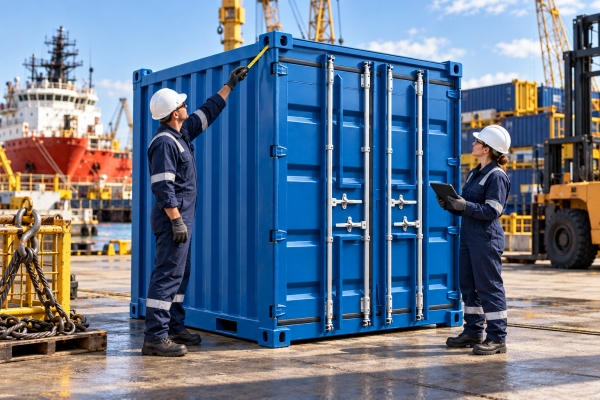
The relevant delivery date is when both the container and its accepted documents are ready at the nominated shore base. A proposal containing only the size, payload and a general statement of DNV compliance is not detailed enough for a reliable comparison.
Frequently asked questions
What is the difference between a DNV offshore container and a standard shipping container?
A standard shipping container is designed mainly for transport by ship, rail and road. A DNV offshore container is designed for repeated crane lifting between supply vessels and offshore installations, where it may experience dynamic loads, impacts and harsh marine conditions. It also requires an approved lifting set and offshore certification documentation.
Which offshore container type is best for heavy tools and equipment?
The choice depends on the equipment’s weight, dimensions, support points and loading method. Half-height containers are often suitable for dense items such as chains, anchors and heavy tools. Cargo baskets work well for long equipment, while open-top containers provide better access for machinery loaded by crane. The supplier should assess both total weight and how the load is distributed.
Should Australian buyers rent or purchase offshore containers?
Rental usually suits short projects, changing fleet requirements and standard container types. Purchasing is often more practical for long-term use or containers requiring substantial customisation. Buyers should compare transportation, inspection, maintenance, storage and return costs rather than considering the rental or purchase price alone.
Does DNV 2.7-1 certification cover workshops and equipment installed inside the container?
DNV 2.7-1 primarily addresses the offshore container structure and lifting arrangement. A workshop, laboratory or equipment module may also require electrical, fire-safety, ventilation, hazardous-area or operational approvals. These requirements must be specified and assessed separately for the intended offshore installation.
What should I send MagOffshore for a useful quotation?
Send a cargo or equipment drawing, individual weights, loading method, required access, operating conditions, certification requirement, quantity and Australian receiving base. Submit these through MagOffshore’s offshore container enquiry.
Final Thoughts
Australia’s offshore container market includes regional rental operators, local equipment suppliers and international manufacturers serving projects by export. The right choice depends on more than container size or a general DNV claim. Buyers need to consider the cargo, loading method, weight distribution, required certification, delivery location and support throughout the equipment’s working life.
Before placing an order, compare suppliers against one consistent technical specification. A strong proposal should explain how the cargo will be loaded, supported, secured and lifted, while providing documentation that connects the approved design, manufactured container and lifting set.
-
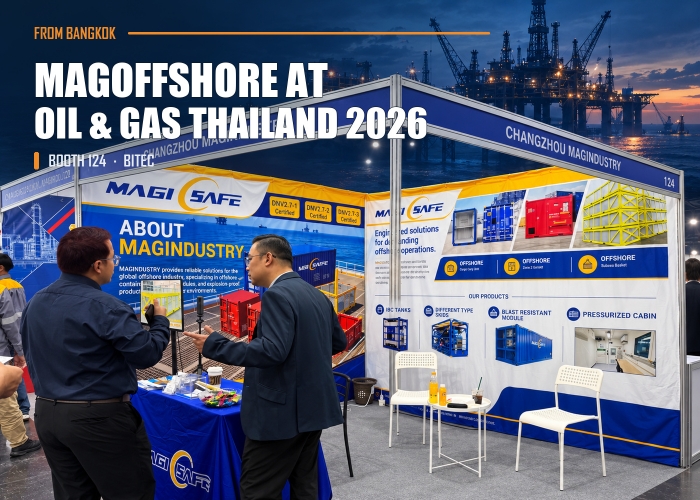 MagOffshore is connecting with energy and offshore professionals at Oil & Gas Thailand 2026 in Bangkok. At Booth 124, the team is presenting offshore cargo carrying units, service modules and engineered solutions while discussing practical project requirements with visitors from across the region.Blog
-
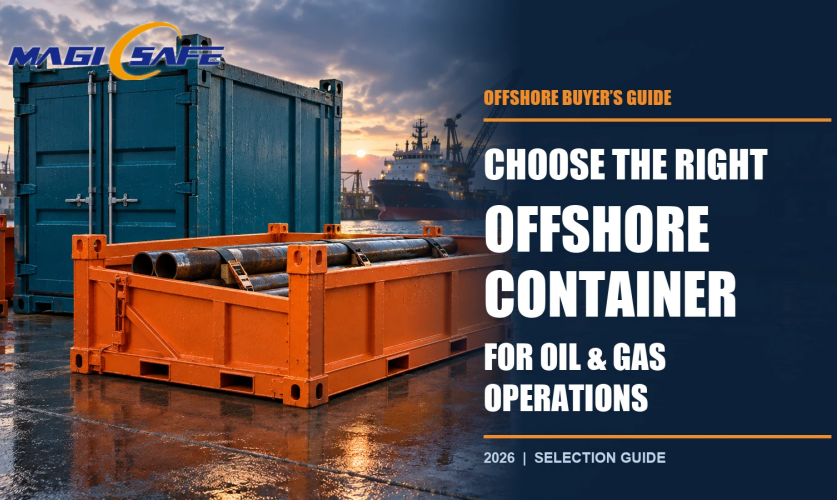 This guide explains how to choose an offshore container based on cargo, loading method, lifting route and certification. It compares common container types and highlights the details buyers should confirm before ordering.News
-
 Compare 10 blast resistant building manufacturers for Qatar projects, with guidance on blast ratings, HVAC, standards and buying requirements.News
