


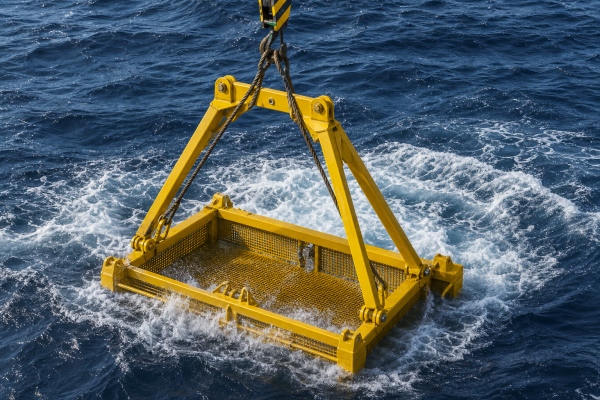
Choosing a subsea basket is not simply a matter of matching length and payload. Norwegian offshore projects may also need a defined subsea lifting class, verified structural calculations, an ROV-friendly layout, secure tool parking, hydrodynamic suitability, corrosion protection, sea-fastening interfaces and a complete certification dossier. A basket intended only for deck-to-platform logistics is not automatically suitable for lowering equipment through the splash zone or placing it on the seabed.
This 2026 guide presents ten manufacturers and suppliers relevant to buyers in Norway. “In Norway” includes Norwegian manufacturers, companies with a verified Norwegian operation, and specialist suppliers that publicly state that they fabricate in or serve Norway. The best choice depends on the project design basis and the evidence supplied for the specific unit.
What Is a Subsea Basket?
A subsea basket is an open or partially enclosed structural unit used to deploy, recover, transport or park tools and equipment underwater. Typical payloads include ROV tooling, flying leads, hoses, intervention equipment, small manifolds, installation aids and maintenance materials. Designs may use a four-leg sling, a single-point A-frame, a centre pole, hinged sides, removable lids, guideposts or dedicated tool interfaces.
The term is sometimes used loosely for an offshore cargo basket. The distinction matters. A DNV-ST-E271 offshore container is primarily designed for repeated transport between shore, vessels and installations. A portable offshore unit assessed under DNV-ST-E273 (formerly DNV 2.7-3) may include project-specific loads and subsea lifting conditions. The correct standard and certification route must be agreed with the purchaser, operator and certifying body; a product name alone does not prove subsea suitability.
TOP 10 Subsea Basket Manufacturers and Suppliers to Consider

1. MagOffshore
MagOffshore supplies purpose-built subsea baskets for transporting, storing and deploying offshore tools, pipes, subsea frames and oversized project cargo. Its published range spans 3 m to 21 m and combines open-top access with heavy-duty structural-steel frames, stackable configurations and corrosion-protection systems for demanding marine environments. Applications include offshore oil and gas, subsea construction, offshore wind and vessel-based engineering operations.

The main advantage for Norwegian project buyers is design flexibility. Basket dimensions, payload, lifting points, mesh panels and protective coating can be configured around the cargo and handling plan instead of forcing a complex load into a standard rental footprint. This makes MagOffshore particularly relevant for long equipment, irregular loads and repeat-use project assets. Units can be developed for a specified DNV 2.7-3 certification basis, subject to the agreed design scope and third-party approval for the individual project.
2. Saga Subsea
Saga Subsea is based at Killingøy Offshorebase in Haugesund. Its published technical sheets show a strong focus on deployment rather than simple transport. The company presents heavy-duty, 12 ft, 20 ft side-opening and centre-pole configurations. Its heavy-duty basket uses an A-frame and single lift point intended to improve ROV intervention, while doors and grabber bars support subsea access and handling.
The published heavy-duty model lists a 12,500 kg payload and DNV 2.7-3 certification; the 12 ft sheet describes a 13,000 kg payload and design to DNV 2.7-3 R60 S45. These are model-specific statements, so buyers should confirm the certificate, operational class and allowable loading for the exact unit offered. Saga is a compelling option for projects where ROV interaction and seabed stability drive the design.
3. Norwegian Offshore Rental
Norwegian Offshore Rental lists a multipurpose 4Te subsea basket certified according to DNV 2.7-3. Its public product information states a 4,000 kg payload and 1,085 kg weight in air, with optional compartments and a hatch using an ROV lock.
This focused configuration may suit inspection, maintenance and repair campaigns that need a readily understood rental asset rather than a one-off fabrication. Rental buyers should still check availability, current inspection status, lifting-set compatibility, offshore logistics, seabed conditions and whether the basket configuration matches the planned ROV tasks.
4. A. Olufsen Ship & Offshore
A. Olufsen Ship & Offshore operates in Haugesund and states that it builds steel subsea baskets in different sizes for transporting tools and equipment to the seabed. The company also fabricates lifting points, material cages, weights and custom steel, aluminium and stainless-steel structures.
That combination makes AOSO relevant when a basket is one part of a wider locally fabricated handling package. Its public page emphasizes customization rather than a fixed catalogue. Buyers therefore need a detailed data sheet in the RFQ and should agree the governing standard, certification body, dynamic factors, material grade, design temperature, sling arrangement, finish and documentation scope before manufacture.
5. Mechman
Mechman in Jørpeland describes subsea baskets for transporting equipment between a vessel and the seabed, supporting ROV operations and heavy lifts at small or large depths. The company states that its baskets are designed, manufactured and certified to stringent requirements and can be supplied with capacities up to 20 tonnes.
The 20-tonne capability makes Mechman noteworthy for heavier intervention packages. However, capacity is only one input. A buyer should request the offered model’s MGW, tare, payload distribution, centre-of-gravity limits, lifting configuration, hydrodynamic design assumptions and approved operating envelope. The certification basis should be written into the purchase order.
6. Imenco
Imenco is a Norwegian technology group with subsea engineering capabilities. Its 20 ft subsea basket sheet says that standard baskets are built to stock and that in-house capability is available to design, engineer and produce tailored units. The stated purpose is safe and efficient transport of equipment to and from subsea locations.
Imenco may appeal to buyers who want the basket supported by a broader subsea engineering organization. Because the public sheet is concise, procurement teams should obtain the latest data sheet and confirm certification, payload, dimensions, lifting arrangement, rental or sales terms, inspection status and documentation package directly.
7. UDECO
UDECO offers UBAS, a multifunctional subsea basket system with multiple sizes and capacities. Publicly listed configurations include general work baskets, compartments and lids, guidance arrangements, ROV tool deployment and parking, test or commissioning manifolds, hinged sides for ROV or diver use, clump-weight functions, and deployment of electrical or optical flying leads.
This modular approach is attractive when the basket is part of the subsea work method rather than passive cargo packaging. Buyers should define every bolt-on feature, interface load, tool-retention arrangement and subsea operating step. The final design review should address snagging, dropped-object risk, visibility, ROV access and recovery contingencies.
8. Hermes
Hermes in Randaberg lists numerous 20 ft subsea baskets available for rental or purchase. The company states that these units are constructed to DNV 2.7-3 and use a four-point lifting arrangement, galvanized grating floor, two wire-rope slings connected by a master link, D-rings and a safety net.
Hermes is relevant when schedule and fleet availability are more important than developing a new design. The unit identifier matters: buyers should review the current certificate, inspection history, sling certification, dimensional drawing, tare, payload and any restrictions for the particular serial-numbered basket reserved for the campaign.
9. Stava Mekaniske Verksted
Stava Mekaniske Verksted in Veavågen manufactures standard and special steel baskets for offshore, maritime and industrial use. Its product range includes a subsea variant as well as gated, ramped and shaft baskets, with customization of dimensions and details.
Stava can be a practical west-coast fabrication option for buyers who value direct design discussion and local delivery. Its webpage shows both subsea and DNV 2.7-1 basket references, which should not be treated as interchangeable. The purchaser must make the underwater use case explicit and confirm which standard, calculations, tests and third-party approvals apply to the proposed subsea unit.
10. Novo Subsea
Novo Subsea publishes one of the broadest specialist catalogues in this list. It includes cube, centre-pole, A-frame, 10–40 ft, man-riding, scissor-frame, guidepost-extension, diver-work and I-tube basket concepts. The company offers standard or custom units for sale or rental and says its fabrication network includes facilities in Norway, the UK and Singapore.
Novo may suit projects needing a less conventional geometry or a supplier able to coordinate internationally. Personnel-related and diver-use configurations require particularly careful regulatory and class review; a generic basket certificate must never be assumed to authorize personnel lifting.
Important Standards and Design Requirements
DNV-ST-E273 / DNV 2.7-3
DNV describes DNV-ST-E273 as covering design, manufacturing, testing and certification requirements for portable offshore units. It is commonly specified for baskets with operational functions or project loads outside the ordinary offshore-container envelope. The design class, operational class and intended subsea lifting conditions must be defined. Saying only “DNV certified” is incomplete because the precise standard, revision, scope and certificate status matter.
DNV-ST-E271 and EN 12079
DNV-ST-E271 and EN 12079 are widely used for offshore containers and associated lifting sets. They can be relevant to deck logistics, but compliance does not automatically validate seabed deployment. Buyers should separate the onshore-to-offshore transport case from the through-water lifting and subsea operating case.
Norwegian requirements and NORSOK R-002
Norway’s Ocean Industry Authority points to NORSOK R-002 for the design and selection of lifting appliances and lifting gear on offshore facilities. Applicability depends on the equipment and operation. The responsible engineering parties should produce a standards matrix covering Norwegian regulations, operator specifications, class rules, machinery requirements and marine-operation procedures.
Engineering inputs beyond payload
The design basis should include MGW, tare, payload geometry, centre of gravity, lift points, sling angles, shock and dynamic amplification, splash-zone effects, added mass, drag, flooding and drainage, seabed landing, impact, snagging, dropped-object prevention, fatigue, design temperature and corrosion protection. ROV handles, doors and locks must be usable with the intended manipulator and visibility conditions.
What Norwegian Buyers Should Check Before Ordering
Start with the operation, not a catalogue size. Provide a cargo drawing and describe the complete route from workshop to quay, vessel deck, splash zone, seabed and recovery. Identify lifting cranes, wire limits, sea-fastening, deck footprint, environmental limits and vessel procedures.
Ask the supplier for a document register before award. It may include approved drawings, calculation reports, design verification, material certificates, welding procedures and qualifications, NDT reports, dimensional inspection, coating records, proof/load-test reports, certificates, lifting-set documents, marking details and operation/maintenance instructions. For rental equipment, request current inspection evidence tied to the unique unit number.
How to Choose the Right Manufacturer
Use a weighted technical and commercial evaluation. First reject offers that do not meet the mandatory design and certification basis. Then compare engineering responsiveness, relevant basket experience, ROV integration, fabrication controls, documentation quality, schedule, transport cost, local service, inspection support and total lifecycle cost.
For a short campaign, an inspected rental unit in Norway may reduce schedule and logistics risk. For unusual tools, long cargo, repeated deployments or a basket that doubles as a subsea work platform, a custom new build can deliver better operational value. The lowest purchase price is rarely the lowest installed cost if offshore time is lost through poor access, unstable landing or documentation gaps.
Why Consider MagOffshore for Norway Projects?
MagOffshore is a practical option when a Norwegian offshore project needs a new subsea basket engineered around the operation rather than selected only by nominal size. The 3–21 m published range supports compact tool baskets as well as long cargo and project-equipment carriers. Open-top loading, configurable mesh panels, lifting points, payload and marine coating allow the basket to be matched to deck handling, sea fastening, offshore lifting and subsea logistics requirements.
The company is best suited to buyers who can define the cargo and operating envelope early. A complete inquiry should include cargo drawings, weight and centre of gravity, required payload, basket dimensions, lifting arrangement, design temperature, offshore destination, expected environmental conditions, ROV interfaces, coating specification and certification requirements. These inputs allow the proposed structure, documentation and inspection plan to be aligned before fabrication.
For Norway-bound projects, request a quotation that clearly identifies the proposed standard, certification scope, drawings, material traceability, welding and NDT records, load-test documentation, coating records and final manufacturing dossier. This gives procurement teams a transparent basis for comparing MagOffshore with local rental fleets and Norwegian custom fabricators. Buyers with a non-standard subsea basket requirement can contact MagOffshore to discuss the technical specification and quotation package.
Frequently Asked Questions
Is a DNV 2.7-1 offshore basket suitable for subsea lifting?
Not automatically. DNV-ST-E271 addresses offshore containers, while project-specific portable offshore unit and subsea conditions may require DNV-ST-E273 or another agreed basis. Ask the designer and certifying body to confirm the exact operation.
What is the difference between a subsea basket and an offshore cargo basket?
A subsea basket is designed around deployment, recovery or equipment handling below the waterline. An offshore cargo basket is generally intended for transporting cargo between a shore base, vessel and offshore installation. Similar-looking units can have different design loads, lifting arrangements and certification scopes, so the intended operation must be stated in the RFQ.
What information is needed for a subsea basket quotation?
Provide cargo drawings, weight and centre of gravity; basket dimensions and payload; lift points and rigging; vessel and crane information; sea states and water depth; deployment method; design temperature; ROV or diver interfaces; sea-fastening; coating; standard and certification requirements; documentation; quantity and delivery location.
Can a supplier customize compartments, lids and tool interfaces?
Many suppliers in this guide publicly offer customization. Every addition changes mass, load paths, hydrodynamics, access or snagging risk, so it should be included in the approved design and final certification scope.
How much does a custom subsea basket cost?
There is no reliable standard price because cost depends on dimensions, payload, steel weight, lifting system, design temperature, ROV features, coating, testing, third-party certification and documentation. A complete cargo and operating specification is required before manufacturers can provide comparable quotations.
Final Recommendation
Norway offers a strong mix of local fabricators, rental specialists and international subsea basket manufacturers. The right supplier depends on how the basket will be used—not simply its dimensions or payload.
For short campaigns, an available rental basket may offer the fastest and most economical solution. Projects involving unusual cargo, repeated deployment, long equipment or dedicated ROV interfaces may benefit more from a custom-built unit. MagOffshore is one option for buyers seeking configurable subsea baskets in lengths from 3 m to 21 m.
Before making a final decision, compare each proposal against the same operating requirements, certification scope and documentation checklist. A well-defined specification will make quotations easier to evaluate and help ensure the selected basket works safely and efficiently throughout the project.
-
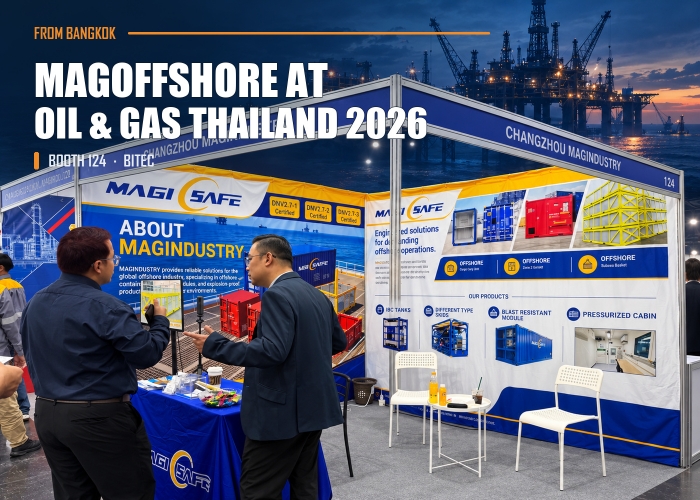 MagOffshore is connecting with energy and offshore professionals at Oil & Gas Thailand 2026 in Bangkok. At Booth 124, the team is presenting offshore cargo carrying units, service modules and engineered solutions while discussing practical project requirements with visitors from across the region.Blog
-
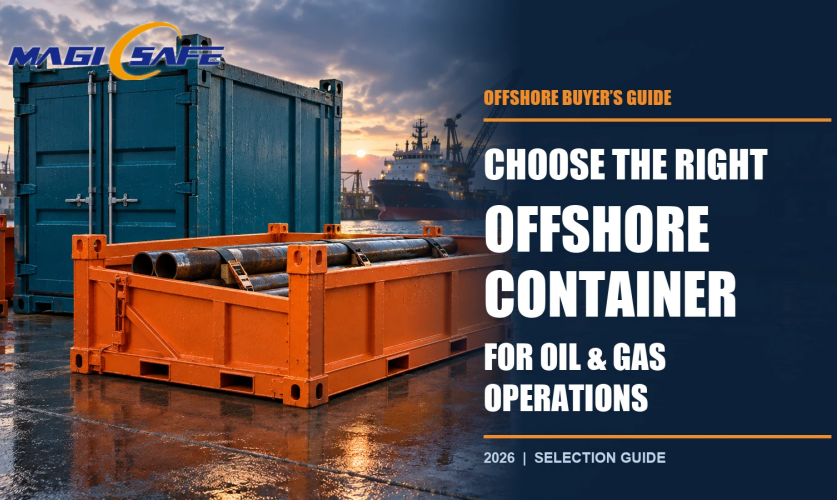 This guide explains how to choose an offshore container based on cargo, loading method, lifting route and certification. It compares common container types and highlights the details buyers should confirm before ordering.News
-
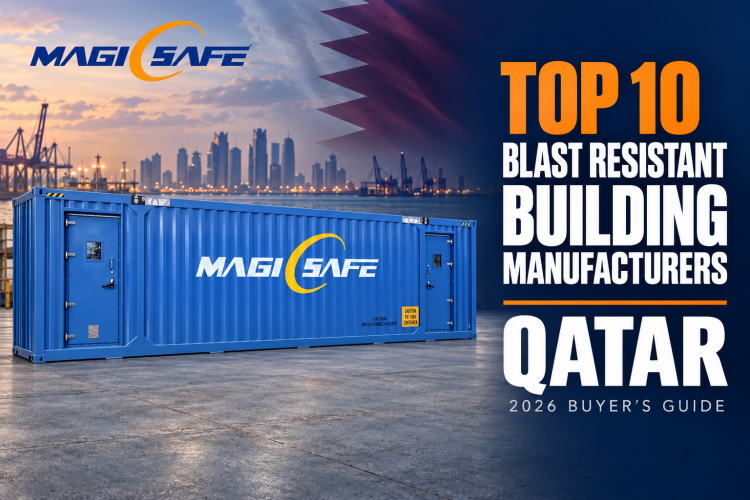 Compare 10 blast resistant building manufacturers for Qatar projects, with guidance on blast ratings, HVAC, standards and buying requirements.News
