


Singapore is one of Asia's most important offshore logistics and marine-engineering hubs. Buyers here need more than a standard shipping box: equipment lifted between a supply vessel and an offshore installation must be engineered, tested, inspected, marked, and documented for that operating environment.
This guide compares ten companies that Singapore buyers can realistically consider in 2026. “In Singapore” includes three different supplier types: companies with a verified Singapore facility or office, manufacturers with Singapore contact and delivery capability, and global specialists that explicitly serve the Singapore market. It does not mean all ten manufacture every unit locally.
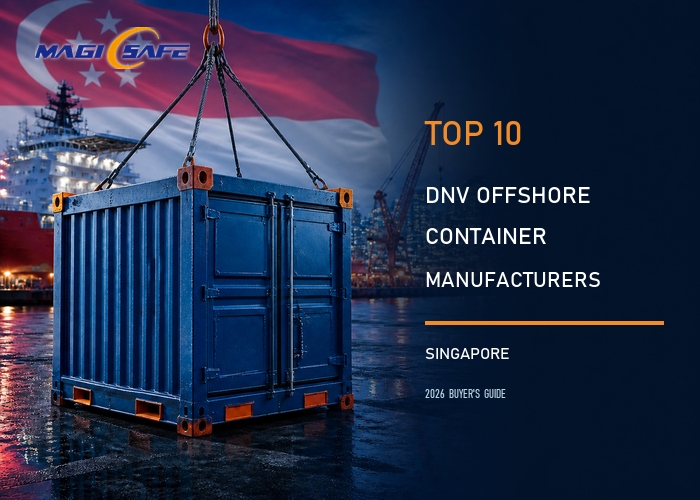
What Is a DNV Offshore Container?
An offshore container is a portable unit designed for repeated transport of goods or equipment between ships and fixed or floating offshore installations. Unlike an ordinary ISO freight container, it may be lifted in open-sea conditions where motion, impact, sling angles, and handling loads are more severe.
DNV-ST-E271, commonly called DNV 2.7-1, covers technical requirements and guidance for offshore containers and lifting sets. DNV states that its scope includes design approval, manufacturing and testing surveillance, final inspection, marking, and periodic inspection. A unit should only be described as “DNV certified” when the relevant certification has actually been issued; a supplier saying that a design is “built to” or “compliant with” the standard is not automatically the same thing.
Common formats include closed cargo containers, open-top and half-height units, baskets, waste skips, tool boxes, reefer containers, tank frames, workshops, laboratories, control cabins, and equipment modules. The right design depends on payload, dimensions, center of gravity, dangerous-goods status, fire rating, hazardous-area requirements, and whether personnel will occupy the unit.
How We Selected the Manufacturers
We reviewed current official product, company, and location pages available in August 2026. Companies scored well when they showed a relevant DNV 2.7-1 or DNV-ST-E271 range, documented Singapore presence or service coverage, engineering capability, custom products, rental or sales support, and clear public evidence.
The list intentionally mixes manufacturers and fleet suppliers because Singapore projects often require both new-build customization and rapid rental availability. Before ordering, buyers should confirm the legal manufacturer, manufacturing location, certification body, individual unit certificate, and local service responsibility in the quotation.
Top 10 DNV Offshore Container Manufacturers in Singapore
1. BSL Offshore Containers
BSL combines a broad product offer with one of the clearest verified local footprints. Its official site lists BSL Offshore Containers Pte Ltd at 10 Tuas South Street 1, Singapore, and describes supply of DNV 2.7-1 and ISO 10855-certified containers, baskets, reefers, tanks, and offshore equipment across Asia-Pacific and the Middle East.
That combination matters for buyers who need local communication, fleet availability, and regional mobilization. BSL is especially suitable for standard cargo-carrying units, baskets, refrigerated units, and tanks. Confirm whether a quoted unit is for rental or sale, the applicable certificate, the inspection status, and the included sling set.
2.MagOffshore
MagOffshore designs and supplies offshore containers and special modules for global oil and gas, marine, and offshore-energy projects, including Singapore enquiries. Its product guidance focuses on DNV 2.7-1 container design, repeated offshore lifting, documentation, and buyer-side specification control.
MagOffshore is a practical choice for custom dimensions, equipment integration, workshops, control cabins, and project-specific modules where a factory-direct engineering conversation is more important than immediate rental stock. Buyers can use the company’s published DNV offshore-container guide to prepare payload, dimensions, lifting, environmental, and certification requirements before requesting a quotation.

3. TLS Offshore Containers
TLS specializes in offshore containers, cabins, and modules and publishes Singapore telephone contacts. Its company profile explicitly identifies Singapore among the markets it supplies. TLS states that its offshore containers are designed, manufactured, and certified to DNV 2.7-1 and EN 12079, with documentation including material traceability, load-test records, and non-destructive-testing reports.
The range extends beyond dry-goods containers to workshops, laboratories, reefer units, accommodation, and pressurized cabins. That makes TLS attractive when structural certification must be integrated with HVAC, fire protection, hazardous-area equipment, or operating systems. Buyers should still define each certification basis separately because DNV 2.7-1 for lifting does not by itself certify fire rating or electrical hazardous-area compliance.
4. Singamas
Singamas is a major container manufacturing group with strong relevance to Singapore through its corporate history and regional position, although its official product page states that production factories are in China. Its 10-foot offshore container is listed as conforming to EN 12079 and DNV 2.7-1, with other sizes available.
The company is a strong candidate for buyers who value manufacturing scale and established container-production processes. Its public specification includes four roof pad eyes and a minus 40°C design temperature. Project teams should request the current drawing revision, type approval or case-by-case certification route, factory location, and exact payload data rather than assuming every Singamas special container carries offshore certification.
5. Seagull Marine
Seagull Marine is a locally relevant option with a Singapore address at Tuas and a public offshore brochure. Its group supports marine and offshore activities and is well placed for buyers who prefer local coordination for fabrication, repair, or equipment integration.
The company is best considered when the order needs practical Singapore-yard communication and broader marine support. Because product configurations and certification status can vary, the purchase specification should identify DNV-ST-E271 or the accepted equivalent, the certification body, lifting set, inspection scope, and final document package for each serial-numbered unit.
6. Technicas
Technicas is a Singapore engineering specialist rather than a high-volume commodity-container supplier. Its official control-container page says it custom designs and manufactures specialized control containers compliant with DNV 2.7-1, ABS, or EN 12079, with Zone 2 options. The company links this capability to nearly two decades of subsea-control experience for remotely operated vehicles.
This makes Technicas particularly relevant for ROV control rooms, subsea equipment, and projects where electrical, control, and hazardous-area integration drive the design. Buyers should distinguish the structural offshore-container certificate from any Zone 2, fire-rating, or installed-equipment approvals and list every required deliverable in the contract.
7. MODEX
MODEX is known for offshore containers and modules offered through a fleet model. Public company material lists a Singapore address and states that equipment is certified to DNV 2.7-1 and EN 12079. Its range is relevant to operators that need rental availability, standard fleet dimensions, and equipment that can move between regional projects.
MODEX is a good shortlist candidate for reefers, cabins, baskets, and cargo units where rental economics or utilization flexibility matters. Ask the local representative for the exact unit’s certificate, current periodic inspection, maintenance history, maximum gross mass, tare, payload, and sling documentation before mobilization.
8. OEG
OEG operates a large global offshore-equipment fleet. Its official pages cover dry-goods, mini, open-top, half-height, refrigerated, workshop, rigging-loft, and transport-frame products. The company states that these units are certified to DNV 2.7-1, BS EN 12079, or ISO 10855, depending on the product and region, and are available for rental or sale.
OEG is suited to multinational operators seeking repeatable fleet specifications and support across several offshore hubs. Its public pages advise customers to confirm exact specifications with the local representative. Singapore buyers should therefore verify the supplying hub, delivery plan, accepted certification route, inspection validity, and whether CSC plating is required for the intended transport chain.
9. 271 Containers
271 Containers has an official Singapore market page stating that it supplies offshore containers and baskets to Singapore. The company promotes DNV 2.7-1-designed products, in-house engineering, customized paint and decals, and purchase, lease, or rental options. Its public range also mentions A60 modules.
It is a useful option for buyers seeking commercial flexibility or a supplier that explicitly accepts Singapore enquiries. The wording on a general market page should not replace serial-numbered evidence: request the final product certificate, manufacturing records, load-test documentation, and any separate A60 or equipment approvals that apply to the ordered unit.
10. Bright Offshore Equipment
Bright Offshore Equipment, also known as BOC, is an Asia-based specialist in tailor-made offshore containers and modules for oil and gas applications. Its official site states that the company is located in Shanghai and highlights design experience with DNV 2.7-1, 2.7-2, 2.7-3, and ISO 10855.
BOC can be considered for custom regional sourcing when Singapore buyers are comfortable managing import logistics and factory inspection outside Singapore. Its inclusion is based on product relevance and Asian manufacturing capability, not a claim of a Singapore factory. Buyers should confirm current certification arrangements, quality surveillance, export packing, delivery responsibilities, and after-sales support.
Important Standards and Design Requirements
DNV-ST-E271 and the “DNV 2.7-1” Name
DNV’s current official standard page uses DNV-ST-E271 and identifies it as 2.7-1 Offshore Containers. The standard addresses offshore containers and lifting sets, including new-build and in-service requirements. Quotations should state the exact edition and amendment required by the operator or contract.
EN 12079 and ISO 10855
EN 12079 and ISO 10855 are widely referenced for offshore containers. Do not treat different names as automatically interchangeable in every contract. The operator, flag, certifying authority, and logistics chain may prescribe a specific standard or marking. Ask the supplier to identify which standard appears on the certificate and data plate.
Certification Is Unit-Specific
DNV explains that certification involves design assessment, manufacturing and testing surveillance, and final inspection. A brochure claim alone is insufficient. The handover package should match the serial number and normally include the product certificate, data plate details, approved design reference, material and welding records as applicable, NDT reports, load-test reports, and lifting-set certificates.
Functional Modules Need More Than Lift Certification
A workshop, laboratory, control room, battery room, or pressurized cabin can require separate fire, electrical, ventilation, hazardous-area, structural, and operational approvals. DNV-ST-E271 addresses the transport unit and lifting basis; it does not automatically prove A60 fire integrity, IECEx or ATEX compliance, or suitability for personnel occupancy.
What Singapore Buyers Should Check Before Ordering
Define maximum gross mass, tare, payload, cargo dimensions, center of gravity, and lifting points.
State whether the unit will carry dangerous goods and whether IMDG or tank approvals apply.
Confirm the required standard edition, certification body, type-approval route, and final product certificate.
Specify design temperature, corrosion system, offshore paint color, drainage, forklift pockets, tie-downs, doors, and roof clearances.
For occupied or powered modules, issue separate HVAC, fire and gas, electrical, pressurization, escape, noise, and hazardous-area requirements.
Identify who supplies the sling set and confirm its certificate, rating, geometry, and inspection status.
Agree on factory surveillance, witness points, document index, punch-list closeout, and Singapore delivery terms.
For rental units, check certificate validity, periodic inspection, damage history, cleanliness, and availability dates.
How to Choose the Right Manufacturer
Start with the operating case, not the catalogue. A standard dry-goods CCU needed quickly may favor a Singapore fleet supplier. A laboratory or control container with project equipment may favor an engineering-led custom manufacturer. Large repeat orders may benefit from a scaled production base with clear third-party surveillance.
Send the same request-for-quotation package to shortlisted suppliers so commercial comparisons are meaningful. Separate base unit price, certification, sling set, installed systems, inspection, documentation, freight, taxes, and commissioning. Evaluate exceptions line by line. A lower initial price can become expensive if the unit needs redesign, recertification, or missing documents before offshore acceptance.
Why Consider MagOffshore for Singapore Projects?
MagOffshore can support standard and customized offshore containers, equipment modules, workshops, and technical cabins with project-specific engineering. Its value is strongest when buyers need a coordinated design covering structure, lifting, internal equipment, interfaces, documentation, and export delivery rather than an off-the-shelf rental unit.
For a useful quotation, provide the destination, required standard, external envelope, payload, equipment list, operating environment, fire or hazardous-area requirements, electrical supply, preferred certification body, quantity, and required delivery date. MagOffshore can then confirm feasibility and the appropriate certification route instead of making a generic compliance promise.
Frequently Asked Questions
Is a DNV offshore container the same as an ISO shipping container?
No. An offshore container is designed for repeated lifting and handling between vessels and offshore installations. An ISO freight container may be suitable for conventional intermodal transport but does not automatically meet offshore lifting and certification requirements.
Does DNV 2.7-1 certification include the lifting sling?
The standard covers offshore containers and lifting sets, but buyers must check the supplied scope and certificates. Confirm whether the sling and shackles are included, correctly rated, compatible with the approved geometry, and within inspection validity.
Can every company on this list manufacture in Singapore?
No. The list includes local facilities and engineering companies, Singapore offices or contacts, and global manufacturers that explicitly serve the market. The manufacturing location for the quoted unit should be confirmed before award.
Should I buy or rent an offshore container?
Rental can suit short projects, standard sizes, and uncertain utilization. Purchase is often better for long-term use, repeated mobilization, custom dimensions, permanent equipment, or branding. Compare total project cost, availability, inspection, modifications, and return logistics.
What documents should arrive with the container?
At minimum, request the serial-numbered product certificate and lifting-set certificates plus the agreed manufacturing, inspection, NDT, testing, coating, and drawing records. Functional modules need additional documents for their installed systems and separate approvals.
Final Recommendation
For local fleet access and broad regional support, begin with BSL. For scaled manufacturing, shortlist Singamas. For complex functional modules, compare TLS, MagOffshore, and Technicas. For rental-led regional programs, investigate MODEX and OEG. Seagull Marine can add Singapore-based coordination, while 271 Containers and Bright Offshore Equipment broaden the custom and commercial options.
Do not award solely on the phrase “DNV 2.7-1 compliant.” Ask each bidder for the proposed certification route, sample document index, exact factory, local support plan, and a clear list of deviations. The best supplier is the one whose certified scope, engineering capability, delivery model, and documentation match the actual offshore operation.
-
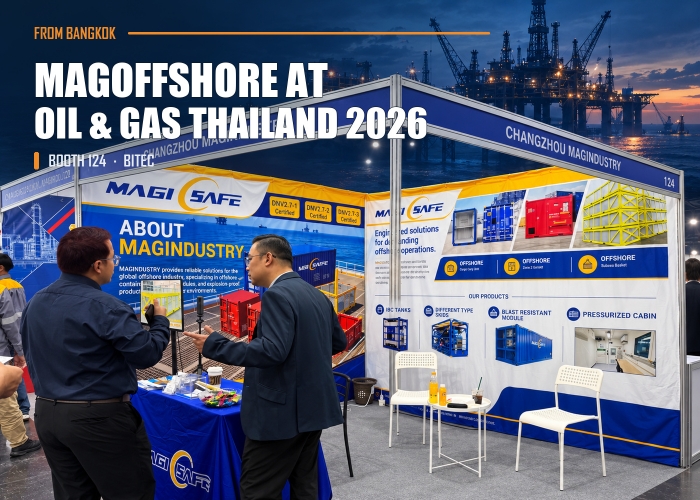 MagOffshore is connecting with energy and offshore professionals at Oil & Gas Thailand 2026 in Bangkok. At Booth 124, the team is presenting offshore cargo carrying units, service modules and engineered solutions while discussing practical project requirements with visitors from across the region.Blog
-
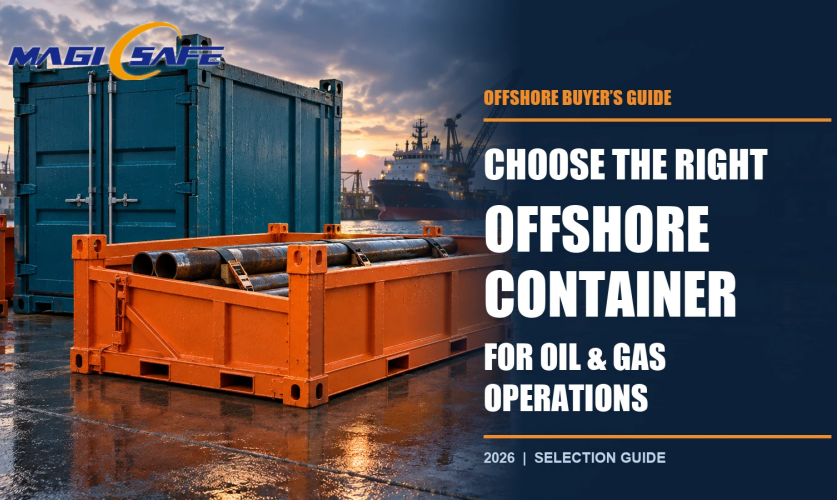 This guide explains how to choose an offshore container based on cargo, loading method, lifting route and certification. It compares common container types and highlights the details buyers should confirm before ordering.News
-
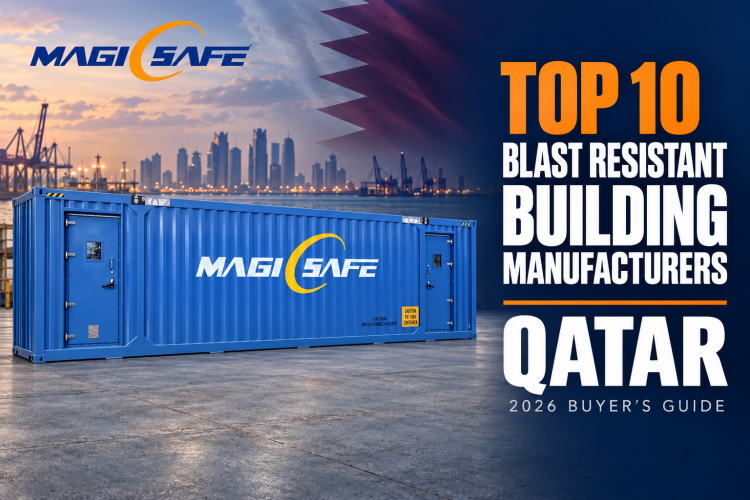 Compare 10 blast resistant building manufacturers for Qatar projects, with guidance on blast ratings, HVAC, standards and buying requirements.News
