


Blast resistant modules (BRMs) protect personnel, control systems, electrical equipment and critical operations in facilities where explosion overpressure may be present. In the United Arab Emirates, these engineered buildings are used across refineries, petrochemical plants, LNG facilities, offshore platforms, drilling operations and other hazardous industrial sites.
However, a BRM is not simply a heavy steel cabin. Its design must respond to a defined blast load, duration, structural response level, occupancy, fire rating, hazardous-area classification and site environment. Buyers also need to consider HVAC pressurization, gas detection, emergency shutdown interfaces, electrical equipment, doors, penetrations, transportation and installation.
This 2026 guide compares ten blast resistant module manufacturers that manufacture in the UAE or clearly support UAE and GCC projects. It is intended as a practical starting point for EPC contractors, operators, engineering consultants and procurement teams. The final supplier decision should always be based on the project specification, verified calculations, approved drawings, third-party review and commercial evaluation.

What Is a Blast Resistant Module?
A blast resistant module is an engineered modular building designed to reduce the effects of a specified explosion on its occupants, equipment and essential functions. The required protection is normally expressed through a pressure-time load, such as a stated peak side-on overpressure combined with a defined positive-phase duration.
BRMs can be configured as:
Process control rooms
Operator shelters
Electrical and MCC rooms
Analyzer buildings and laboratories
Temporary refuge modules
Pressurized cabins
Mud logging or MWD/LWD cabins
Offshore workshops and technical buildings
Emergency response or security shelters
“Blast resistant” does not mean indestructible under every possible event. Performance depends on the design basis. The procurement specification should define the blast load, response criteria, occupancy, fire exposure, hazardous-area requirements and post-event expectations.
How We Selected the Manufacturers
The companies in this guide were assessed using publicly available information reviewed in August 2026. It considers:
Evidence of blast resistant modules, buildings or engineered shelters in the product range
Manufacturing capability in the UAE or a clear ability to serve UAE projects
Experience with oil and gas, petrochemical, offshore or other high-risk industries
Structural, fire, hazardous-area and systems-integration capabilities
Custom engineering, project execution and after-sales support
Clarity and verifiability of public product information
This is an editorial comparison, not a certification, test report or claim of market share. MagOffshore publishes this guide and is included in the list. Buyers should independently verify every supplier's current scope, certifications, facilities and project references.
Quick Comparison of the Top 10 BRM Manufacturers Serving the UAE
Number | Manufacturer | Notable Focus | Best Suited For |
|---|---|---|---|
1 | Hunter Buildings | Custom and rental blast resistant steel buildings | Major oil, gas and petrochemical projects |
2 | MagOffshore | Offshore BRMs, DNV options and hazardous-area integration | Customized offshore and onshore energy modules |
3 | Spacemaker | BlastSpace modules in stated 5, 8 and 10 psi options | Shutdown shelters and rapid regional deployment |
4 | Technomak | Blast- and fire-rated technical buildings | Integrated control, electrical and technical modules |
5 | TrueSea Services | API RP 752/753-guided blast-rated modules | Oil and gas buildings requiring defined response criteria |
6 | RedGuard / Specialist Services | Custom, standardized and rental BRBs | Turnarounds, temporary occupancy and permanent facilities |
7 | AXON Tec | BRMs, A60 units and pressurized modules | Buyers seeking a broad modular package |
8 | Mech-Tool Engineering | Fire and blast systems and modular buildings | Projects with demanding fire-and-blast interfaces |
9 | QMIcore | Blast-resistant modular shelters and safe rooms | Security, government and critical-infrastructure applications |
10 | Blast Lock Tactical Systems | Blast and ballistic modular shelters | Defence, security and specialized industrial protection |
Top 10 Blast Resistant Module Manufacturers in the UAE
1. Hunter Buildings
Hunter Buildings is a specialist in blast resistant steel buildings for industrial operations. Its Middle East presence is particularly relevant to UAE buyers because the company states that it operates a manufacturing facility in the UAE and supports projects across the GCC.
The company offers custom modular buildings, blast resistant shelters, E-houses, technical buildings and remote instrument enclosures. It also provides related site services such as installation, foundation construction and mechanical work. This broader delivery scope can be useful when the building must integrate into a complex operating facility rather than arrive as a standalone shell.
2.MagOffshore
MagOffshore manufactures engineered blast resistant modules for offshore and onshore oil and gas applications and serves EPC contractors, drilling companies, FPSO integrators, shipyards and energy operators worldwide. Its BRM range can be configured as control rooms, workshops, pressurized cabins, MWD/LWD cabins, mud logging units, electrical rooms, laboratories and temporary refuge modules.
The company's published standard reference includes a 40-foot BRM configuration with a 10 psi, 200 millisecond blast rating and an ASCE medium-response design basis. Project solutions can incorporate A60 or optional H60 fire protection, hazardous-area HVAC, positive pressurization, gas detection, emergency shutdown interfaces, Ex electrical equipment, marine coatings and offshore lifting arrangements.

3. Spacemaker
Spacemaker is a UAE modular-building manufacturer with a dedicated blast resistant module product category. Its BlastSpace range is promoted for hazardous environments and shutdown shelter applications.
Public product information describes single-unit configurations with 5 psi, 8 psi and 10 psi options and a stated blast duration of up to 200 milliseconds. This gives buyers a useful initial product reference, although the final design still needs to match the project-specific pressure-time curve, response level and occupancy requirements.
4. Technomak
Technomak is an engineering and construction company headquartered in the UAE. It supplies modular technical buildings with in-house capability covering design, engineering, procurement, manufacturing, installation and commissioning.
Its published modular-building scope ranges from non-rated cabins to multi-storey blast- and fire-rated modules. Technomak states that it can provide buildings designed for blast overpressure on walls and decks based on client requirements, together with blast analysis and calculation packages for third-party review. Its fire-rated options include several offshore and industrial ratings.
5. TrueSea Services
TrueSea Services supplies blast-rated modules, fire-rated buildings and related industrial products from the UAE. The company states that its modules are designed by a UK-based team and manufactured at its UAE production facility following the guidelines of API Recommended Practices 752 and 753.
TrueSea also explains low-, medium- and high-response performance categories. This distinction matters because two buildings exposed to the same pressure may be designed for different deformation and post-event conditions.
6. RedGuard / Specialist Services
RedGuard is an established blast resistant building specialist offering custom and standardized steel modular products as well as rental solutions. Its SafetySuite custom buildings are promoted for project-specific multi-hazard applications, while standardized product lines support faster selection for common requirements.
For the Middle East, RedGuard's capabilities are linked with Specialist Services, a company with facilities and service teams in Dubai and Abu Dhabi. Public information has described their cooperation in supplying blast resistant, ballistic and offshore Zone 1 modules across the region.
7. AXON Tec
AXON Tec supplies prefabricated and containerized buildings across UAE industries. Its published specialized-module range includes blast resistant modules, A60 fire-rated units, offshore laboratories, pressurized modules, Zone 2 units, workshops, reefer units and pump or compressor skids.
The breadth of this range can benefit projects that require several related module types from one supplier. For example, an operator may need a blast resistant control room together with a pressurized laboratory, workshop or equipment skid.
8. Mech-Tool Engineering
Mech-Tool Engineering has decades of experience in fire and blast protection for offshore and onshore industries. Its capabilities cover fire and blast wall systems, modular buildings and related engineered protection products, with a published Middle East contact in the UAE.
The company is particularly relevant where the module's performance depends on detailed integration between the structural enclosure, fire-and-blast boundaries, ducting, penetrations and project-specific offshore requirements. Such interfaces can be as important as the primary steel frame.
9. QMIcore
QMIcore designs, manufactures and installs blast-resistant modular shelters and safe rooms at its Dubai Industrial City facility. QMI also publishes capabilities in blast-resistant doors, fire-rated systems, ballistic protection and CBRN-related protective solutions.
Its vertically integrated approach covers structural design, fabrication, installation and commissioning. However, its typical applications include embassies, schools, government institutions and private or critical-security sites, so its market emphasis differs from a conventional refinery control-room BRM supplier.
10. Blast Lock Tactical Systems
Blast Lock Tactical Systems is a UAE-based manufacturer of modular ballistic shelters, blast-resistant pods and mobile fortified cabins. Its published sectors include defence, government, emergency response and oil and gas.
The company's solutions emphasize modular deployment, blast and ballistic protection and integrated options such as HVAC, CCTV and communications. This makes it relevant to projects where security threats and industrial hazards overlap.
Important Standards and Design Requirements
A manufacturer name or a stated psi rating is not enough to approve a BRM. The project team should define and verify the complete design basis.
API RP 752 and API RP 753
API RP 752 addresses the management of hazards associated with the location of permanent buildings in process plant areas. API RP 753 covers portable buildings. These recommended practices help facility owners assess building siting and occupancy risk; they are not product certificates that can simply be attached to a module.
Blast Load and Structural Response
The data sheet should identify peak overpressure, impulse or duration, load direction, reflected effects where applicable, acceptable response category and post-event performance expectations. Door, window, penetration and connection performance must be compatible with the building envelope.
Fire and Hazardous-Area Requirements
Offshore or process modules may also need A60 or H60 fire protection, fire and gas detection, emergency shutdown logic, hazardous-area electrical equipment, pressurization and HVAC shutdown or isolation. The required standards depend on the location and application.
Offshore Transport and Certification
Modules intended for offshore lifting may require a separate structural and certification basis such as DNV-ST-E271/DNV 2.7-1, EN 12079 or another classification route. Blast resistance does not automatically make a building suitable for offshore lifting, and offshore certification does not automatically prove the required blast performance.

What UAE Buyers Should Check Before Ordering
UAE projects combine high ambient temperatures, solar exposure, dust, saline coastal conditions and demanding oil and gas specifications. The following checks should be completed before contract award.
Site and Engineering Checks
Provide the blast pressure-time data, response criteria, occupancy, fire rating, hazardous-area classification and environmental conditions. Avoid requesting only a generic “10 psi module.”
Size HVAC for UAE ambient conditions and internal heat loads. Define pressurization, purge logic, gas detection, dampers and shutdown behavior.
Confirm steel grades, welding, insulation, coating and protection of external equipment against heat, dust and coastal corrosion.
Agree module weight, center of gravity, lifting points, transport supports, foundation loads and installation responsibility.
Require calculations, drawings, material records, inspection plans, certificates, FAT procedures and operation manuals.

How to Choose the Right BRM Manufacturer
Use a structured technical and commercial evaluation rather than choosing only by price or a headline blast rating.
Issue the same data sheet and document requirements to every bidder.
Confirm whether each bidder is offering a standard module or a project-specific engineered design.
Review comparable project references and the proposed engineering team.
Compare exclusions for HVAC, fire and gas, electrical systems, furniture, testing, certification, transport and installation.
Require a clear third-party verification and inspection route.
Evaluate delivery schedule together with engineering approval milestones.
Assess regional commissioning, spare parts and after-sales support.
Complete technical clarification before final commercial comparison.
Why Consider MagOffshore for UAE BRM Projects?
MagOffshore focuses on engineered offshore modules and hazardous-area solutions rather than general-purpose prefab buildings. This allows the company to combine structural blast design with systems required for demanding energy projects.
Key capabilities include:
Customized blast ratings and structural response design
Offshore lifting and DNV certification options
A60 and optional H60 fire-rated construction
Zone 1 and Zone 2 hazardous-area configurations
Pressurized HVAC and fire-and-gas integration
Ex electrical packages and emergency shutdown interfaces
Control rooms, workshops, laboratories, MWD/LWD cabins and temporary refuges
FAT, material traceability and third-party inspection support
International delivery for UAE and wider Middle East projects
Send MagOffshore your module dimensions, application, blast load and duration, response requirement, fire rating, hazardous-area classification, ambient conditions, certification route and required internal systems. The engineering team can then prepare a project-specific proposal rather than a generic enclosure quotation.
Frequently Asked Questions
What is the difference between blast resistant and explosion proof?
Blast resistant describes a structure engineered to respond to a defined explosion load. “Explosion proof” is often used loosely and can imply unlimited protection, which no practical building provides. Procurement documents should use measurable blast loads and response criteria.
What blast rating is commonly used for a BRM?
There is no universal rating. Projects may specify different pressures and durations based on a facility hazard assessment. A value such as 5, 8 or 10 psi is incomplete without duration, load definition and response criteria.
Do API RP 752 and API RP 753 certify a module?
No. They are recommended practices for managing building-location hazards in process areas. Compliance decisions involve the facility siting study, occupancy and risk management as well as building performance.
Can a BRM be installed offshore?
Yes, if it is also engineered for offshore transport, lifting, corrosion, fire, hazardous areas and the selected classification or certification requirements. A land-based BRM should not be assumed suitable for offshore lifting.
Can a blast resistant module be used as a control room?
Yes. BRMs are commonly configured as operator or process control rooms with HVAC, electrical distribution, monitoring systems, communications, fire and gas interfaces and emergency shutdown functions.
How should a buyer compare BRM quotations?
Compare the blast design basis, structural response, dimensions, weight, fire rating, HVAC, hazardous-area scope, doors and penetrations, certification, testing, documentation, transport, installation and exclusions—not only price and psi rating.
How long does a custom BRM take to manufacture?
Lead time varies with engineering complexity, approval cycles, equipment availability, certification and factory workload. The supplier should provide separate dates for data approval, design review, procurement, fabrication, FAT and delivery.
What information should be included in an RFQ?
Include the application, location, dimensions, blast pressure and duration, response criteria, occupancy, fire rating, hazardous-area classification, environmental conditions, HVAC loads, electrical supply, equipment list, certification, testing, documentation, transport and installation requirements.
Final Recommendation
The UAE market offers a strong mix of local manufacturers, global BRM specialists and protective-structure companies. Hunter Buildings, Technomak and Spacemaker provide notable regional capability, while MagOffshore offers a flexible route for customized offshore and hazardous-area modules. TrueSea, RedGuard/Specialist Services, AXON Tec and Mech-Tool add further industrial options, and QMIcore and Blast Lock address more security-focused protection needs.
The best manufacturer is not necessarily the largest company or the supplier quoting the highest psi value. It is the one that can demonstrate a correct design basis, integrated engineering, verifiable documentation, suitable manufacturing controls and reliable delivery for the specific UAE project.
-
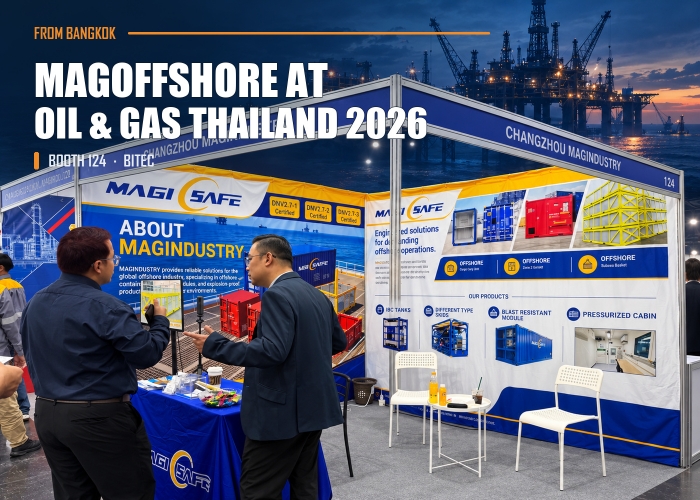 MagOffshore is connecting with energy and offshore professionals at Oil & Gas Thailand 2026 in Bangkok. At Booth 124, the team is presenting offshore cargo carrying units, service modules and engineered solutions while discussing practical project requirements with visitors from across the region.Blog
-
 This guide explains how to choose an offshore container based on cargo, loading method, lifting route and certification. It compares common container types and highlights the details buyers should confirm before ordering.News
-
 Compare 10 blast resistant building manufacturers for Qatar projects, with guidance on blast ratings, HVAC, standards and buying requirements.News
