


Offshore maintenance rarely happens under ideal conditions. Tools must remain organized while the unit is lifted, electrical equipment has to suit the area classification, ventilation must control heat and fumes, and technicians need enough room to work without blocking the escape route. In Saudi Arabia, high ambient temperatures, airborne dust and salt-laden Gulf air add another layer to the design.
The companies below represent a useful cross-section of the market in 2026. Some offer rental fleets and inspection support inside Saudi Arabia, while others manufacture custom workshops for delivery into the Kingdom. Together, they cover mechanical workshops, E&I rooms, welding units, rigging lofts, valve-repair shops and specialist maintenance modules.

What Makes an Offshore Workshop Container Different?
An offshore workshop container combines two engineering functions. First, it is a cargo carrying unit designed for repeated lifting between a shore base, supply vessel and offshore installation. Second, it is an operating space containing tools, machinery, electrical systems and, in many cases, personnel.
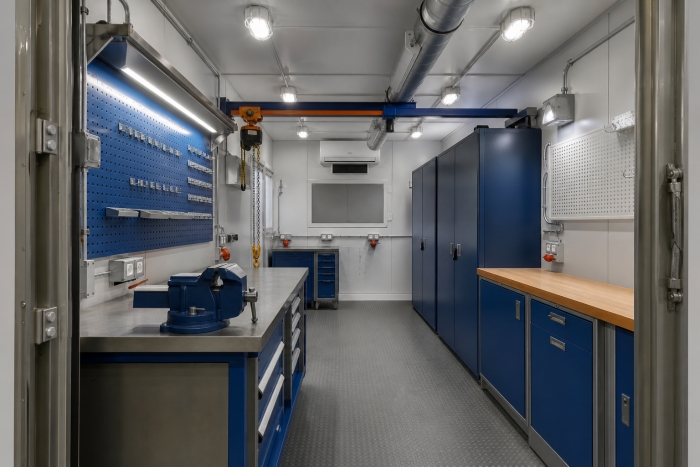
The lifting structure normally incorporates certified padeyes, a reinforced base, forklift pockets, tie-down points and a matched sling set. Inside, the layout may include benches, vices, tool cabinets, monorails, small cranes, compressed-air connections, local extraction and equipment-specific fixtures. HVAC, lighting, sockets, fire detection, gas detection and emergency systems are selected around the operating environment.
This is why a workshop cannot be evaluated from its external dimensions alone. A 20 ft unit for safe-area mechanical repairs has a very different design basis from a pressurized Zone 1 E&I workshop, even when both use the same nominal footprint.
How the Manufacturers Were Assessed
The main considerations were offshore workshop experience, structural and systems engineering, hazardous-area options, internal customization, rental or local service capability, and relevance to Saudi oil, gas and marine projects.
In this article, “in Saudi Arabia” includes manufacturers based in the Kingdom, companies with Saudi operations, regional Gulf suppliers and international manufacturers that can support an imported new-build project. The manufacturing location and local service model therefore vary from one supplier to another.
Offshore Workshop Container Manufacturers and Suppliers
1. ARMCO
ARMCO has a useful advantage for Saudi projects: its offshore container operation is based in Jubail. The company supplies, rents, inspects and recertifies offshore CCUs, and its published range includes A60 accommodation/workshop modules as well as 10 ft laboratory and 20 ft workshop units.
Its role is broader than equipment supply. Storage, mobilization, lifting gear and inspection services can all affect how quickly a unit reaches an offshore campaign. Custom builds are coordinated through international partner workshops, so the quotation needs to identify the actual manufacturer, fabrication location and certificate holder. ARMCO is well suited to projects where local logistics and ongoing inspection support carry significant weight.
2. MagOffshore
MagOffshore develops custom workshop containers for mechanical maintenance, welding support, electrical and instrumentation work, rigging operations and tool storage. Its published configurations include 10 ft, 20 ft and purpose-built dimensions, with options for safe areas, Zone 1 or Zone 2 locations.
The internal arrangement can combine heavy-duty benches, cabinets, extraction, HVAC, electrical distribution and equipment-handling features. A60 construction and marine corrosion protection are also available within the product range. This flexibility is valuable when a Saudi project has high cooling loads, non-standard equipment, limited deck space or a specific power interface.
 |  |
The most effective starting point is an equipment layout rather than a generic container inquiry. Once tool weights, personnel, heat release, ventilation demand and area classification are known, the structure and operating systems can be developed as one package.
3. OEG
OEG maintains a cargo-logistics office in Al Khobar and supports Saudi Arabia through its Middle East operation. Its workshop fleet covers mini, 10 ft, 15 ft and 20 ft units, including safe-zone and pressurized variants available for rental or sale.
Typical options include benches, cabinets, shelving, sockets, air-conditioning, jib hoists, pneumatic lines, escape hatches and safety equipment. OEG’s regional fleet and integrity services make it especially relevant for operators that prefer to rent and maintain standardized assets. Specifications differ across the fleet, so selection is normally made against a particular unit number and data sheet.
4. AMCON
AMCON is a Dammam-based fabricator whose published scope includes DNV offshore containers, offshore modules, skids and dry-cargo units. Its wider fabrication capability covers tool containers, machining, piping, coating and load-bearing steel structures.
The company does not publish a standard offshore workshop model, but its local engineering and fabrication base makes it relevant for project-specific discussions. The key question is whether the complete proposed workshop—including the occupied space, electrical installation and safety systems—falls within its demonstrated engineering and certification capability.
5. Al Bahar MCEM
Al Bahar MCEM has documented experience with a containerized offshore workshop for large-engine support. The published project incorporates a 500 kg under-slung hoist, heavy component racks, movable partitions, tool drawers and protected internal lighting.
That project illustrates a mature approach to workshop design: the equipment being repaired determines the hoist, storage system, access and working clearances. Located in Dubai Industrial City, Al Bahar is geographically well placed for Gulf deliveries and is worth considering for engine, pump or heavy-component maintenance modules.
6. TLS Offshore Containers
TLS designs offshore workshop, laboratory and equipment containers around the intended process. Available systems include air-conditioning, filtered extraction, recirculation, electrical distribution, communications, fire and gas detection, and project-specific internal layouts.
The company also presents engineering support through testing, certification, installation and commissioning. This makes TLS relevant when the container is closer to a compact technical facility than a simple tool room—for example, a laboratory, equipment-control space or workshop with substantial ventilation and electrical integration.
7. SES Energy
SES Energy offers DNV 2.7-1 offshore workspaces for sale or rental and has Middle East and North Africa coverage. Its workspace portfolio extends beyond conventional workshops to pressurized laboratories, drilling modules, ROV workspaces and control rooms.
Standard units can be equipped with insulation, shelving, electrical power, air-conditioning, PA systems and smoke detection, while the engineering team supports bespoke modifications. SES is therefore a useful option when a buyer wants to compare an available fleet asset with a modified or made-to-measure unit.
8. Uniteam
Uniteam’s workshop-with-crane design is aimed at equipment repair, maintenance and storage. The published configuration includes a steel bench, vice, custom shelving, optional insulation and a crane sized for the required lifting duty. Explosion-protected lighting, switches, sockets and cabling are available for classified locations.
An internal crane changes more than the workshop workflow. Its self-weight, rated load, outreach and parked position affect the module structure and centre of gravity. Uniteam is particularly relevant where pumps, valves or other heavy parts must be transferred directly between the doorway and workbench.
9. VG Offshore
VG Offshore manufactures workshop and rigging-loft containers in several standard weight classes and custom dimensions. Its fit-out options include cabinets, benches, vices, tool walls, heavy-duty hooks, monorails, chain hoists, HVAC and either safe-area or explosion-protected electrical systems.
The company also describes factory acceptance testing and pre-commissioning of electrical and instrumentation systems. VG is a strong candidate for buyers who need a highly organized rigging loft or maintenance unit with detailed storage and handling requirements defined before shipment.
10. K.Mass
K.Mass develops containerized valve testing and repair workshops for offshore maintenance work. Its CNVTB-2 concept combines valve test and overhaul equipment with worktables, tool storage, cabinets and internal material-handling equipment inside an offshore container designed around DNV 2.7 and EN 12079 requirements. ATEX electrical systems are available for hazardous-area duties.
The arrangement is relevant where technicians need to receive, dismantle, service and pressure-test valves without moving between separate facilities. Buyers should define valve types, maximum test pressure, lifting loads, utility connections and hazardous-area classification at enquiry stage; these inputs determine the test bench, pipework, ventilation and certification scope of the completed workshop.
Standards and Engineering Decisions That Matter
DNV-ST-E271 and ISO 10855
DNV-ST-E271 covers approval and certification of offshore containers and lifting sets, including design, manufacture, testing, marking and periodic inspection. ISO 10855-1:2024 addresses offshore containers up to 25,000 kg maximum gross mass and is explicitly focused on transport-related requirements.
These standards establish the basis for offshore handling, but they do not by themselves assess every system used while personnel are working inside the container.
DNV-ST-E272 and the complete equipment assembly
DNV-ST-E272 addresses equipment assemblies and includes layout, safety systems, manufacturing, testing, installation, commissioning and operation. Its relevance depends on what is installed and how the unit will be used. Establishing the certification basis early avoids the common problem of completing a DNV lifting structure and discovering later that the operational fit-out requires additional review.
Fire rating and hazardous-area design
A60, H60 and H120 are not interchangeable labels. The required division must be defined together with the boundary orientation, door, ventilation dampers, cable transits and pipe penetrations. Each penetration needs evidence compatible with the wall or deck system in which it is installed.
For a classified location, the area classification determines the equipment category, gas group, temperature class, ambient range and protection concept. IECEx or ATEX certificates apply to identified equipment and assemblies; they do not automatically approve the complete room. Pressurized workshops also require a defined purge sequence, minimum pressure, alarm logic, shutdown philosophy and safe state after loss of pressure.
HVAC, extraction and Saudi environmental conditions
Cooling design should account for outdoor temperature, solar load, occupants, lighting, tools, motors and electrical panels. A nominal air-conditioner selected only from container length can be significantly undersized. Coastal corrosion, dust loading, filter access, condenser fouling and standby capacity also influence reliability.
General comfort ventilation cannot replace source extraction for welding fumes, solvents or battery charging. The ventilation concept must follow the actual work process and hazardous-area philosophy.
Internal equipment and offshore lifting
Every cabinet, machine, gas cylinder and loose tool needs a positive restraint for offshore transport. Heavy equipment affects payload distribution and centre of gravity, while monorails and jib cranes introduce concentrated loads into the roof and side structure. The weight report should cover both the operating condition and the condition used for offshore lifting.
Preparing a Saudi Workshop Container RFQ
A useful RFQ begins with the maintenance task. List the equipment to be serviced, largest component, tool inventory, number of technicians, working positions and any hot work or chemical use. Add the installation data: deck location, area classification, fire boundary, lifting standard, utilities, electrical supply and environmental conditions.
The supplier can then develop the layout, weight control, HVAC duty, ventilation, lighting, handling equipment and escape route around real inputs. This approach produces better proposals than specifying “one 20 ft DNV workshop” and leaving the operating details until after award.
The required document package usually includes approved general arrangements, structural calculations, weight and centre-of-gravity reports, material certificates, welding and NDT records, load-test reports, fire certificates, Ex equipment schedules, electrical drawings, HVAC calculations, FAT records, manuals and as-built documentation.
For imported units, the commercial scope should also state responsibility for Saudi customs clearance, inland transport, site installation, power connection, commissioning, training and warranty support.
Choosing Between Rental and a Custom Build
Rental is often the most efficient route for a short maintenance campaign when the required workshop type is already available in the region. It reduces fabrication time and may include inspection, maintenance and local mobilization. The trade-off is limited freedom to change the layout or installed systems.
A custom build becomes more attractive when the unit will remain offshore for a long period, support a proprietary tool package, contain heavy handling equipment or operate in a demanding classified area. The comparison should include modification costs, certification, freight, commissioning and expected reuse—not only the purchase price or daily rental rate.
When MagOffshore Is a Good Fit
MagOffshore suits projects where the workshop has to be built around a specific process. Mechanical, welding, E&I and rigging-loft layouts can be configured with the required benches, storage, HVAC, extraction, electrical distribution and handling equipment.
The offshore workshop container range provides a starting point for 10 ft, 20 ft and custom units. For a Saudi quotation, the most useful inputs are the equipment layout, personnel count, area classification, fire rating, ambient conditions, heat loads, power supply, lifting weight and any crane or monorail duty.
A well-structured offer should separate the offshore structure, internal fit-out, hazardous-area equipment, third-party approval, testing, documentation, freight and commissioning. This allows a direct technical comparison with local fleet providers and regional manufacturers.
Frequently Asked Questions
What is the difference between an offshore workshop and a converted shipping container?
An offshore workshop is designed for repeated offshore lifting and includes certified padeyes, a reinforced structure and an offshore lifting set. Its fire, ventilation, electrical and safety systems are also developed around the operating location. A converted shipping container does not automatically meet these requirements.
Does DNV 2.7-1 cover personnel working inside the workshop?
DNV-ST-E271 primarily addresses the offshore container and lifting set. The installed equipment and occupied operation may require DNV-ST-E272, fire-test evidence, hazardous-area certification and operator-specific review.
Is A60 always required?
No. The required fire division depends on the installation fire-risk assessment and location of the unit. Some applications use A-class divisions, while hydrocarbon-fire exposure may lead to an H-class requirement. The complete wall, door and penetration system must match the specified rating.
Can a Zone 2 workshop be used in Zone 1?
Not without a separate assessment and suitable equipment or protection concept. Zone 1 generally requires a higher level of protection because an explosive gas atmosphere may occur during normal operation. The project area-classification drawing governs the requirement.
What information is needed to size the HVAC system?
Provide the outdoor design temperature, solar exposure, occupancy, lighting load, electrical and mechanical equipment heat, ventilation rate, door-opening pattern and any standby philosophy. Dust and salt exposure should also be included in equipment and filtration selection.
Which documents should be checked before shipment?
Review the approved drawings, final weight and centre of gravity, structural and lifting certificates, load-test report, fire and Ex documentation, electrical test records, HVAC performance, FAT results, punch-list closure and complete as-built dossier.
Conclusion
Start with the operating brief, then separate the market into three groups. For a standard unit needed quickly, check fleet availability and local support from ARMCO or OEG. For a Saudi-fabricated solution, discuss the full workshop and certification scope with AMCON. For a specialist new build, compare MagOffshore, Al Bahar, TLS, SES, Uniteam, VG and Dragon against the same equipment list and certification matrix.
The strongest proposal is usually the one that resolves working clearances, heat loads, equipment restraint, fire boundaries, Ex interfaces and Saudi delivery responsibility before fabrication begins. Those details determine whether the container becomes a useful offshore workshop or simply an expensive enclosure.
-
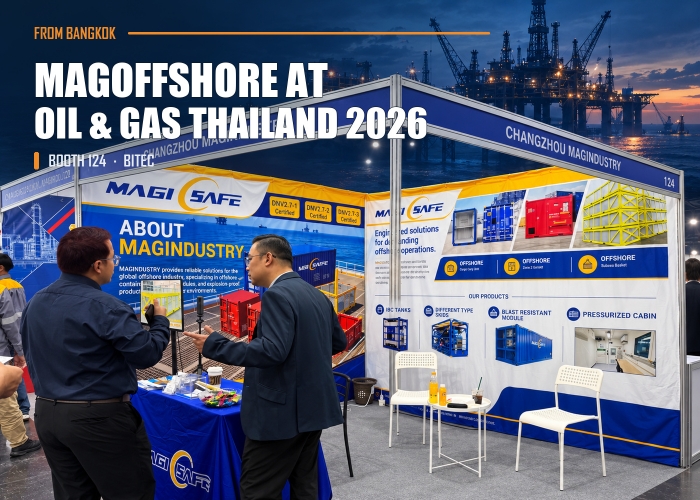 MagOffshore is connecting with energy and offshore professionals at Oil & Gas Thailand 2026 in Bangkok. At Booth 124, the team is presenting offshore cargo carrying units, service modules and engineered solutions while discussing practical project requirements with visitors from across the region.Blog
-
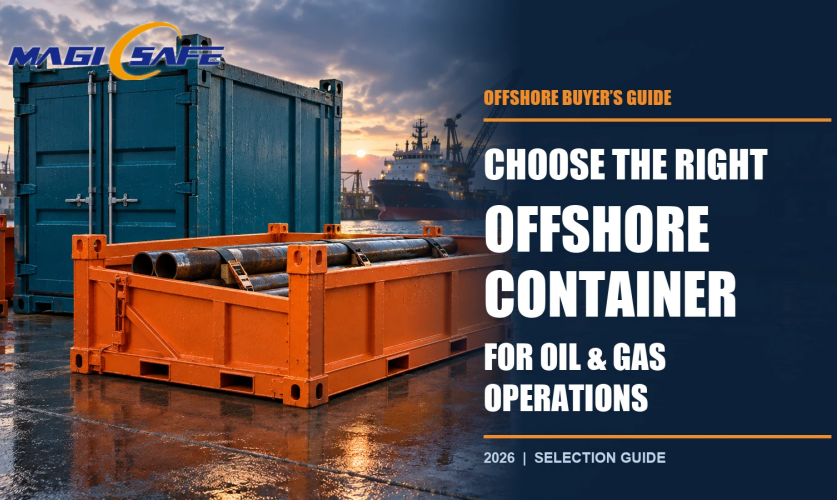 This guide explains how to choose an offshore container based on cargo, loading method, lifting route and certification. It compares common container types and highlights the details buyers should confirm before ordering.News
-
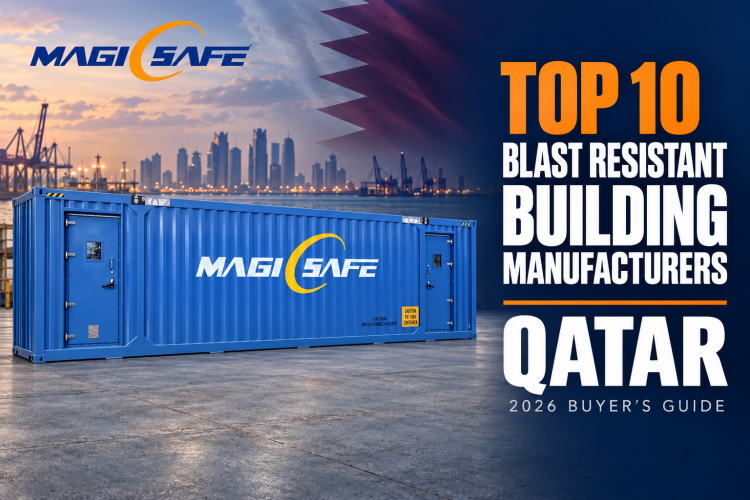 Compare 10 blast resistant building manufacturers for Qatar projects, with guidance on blast ratings, HVAC, standards and buying requirements.News
